

What Is the 2026 R2T4 Denominator Rule?
The 2026 R2T4 denominator rule requires institutions to include only the modules a student actually begins when calculating scheduled days for the Return of Title IV Funds (R2T4) denominator.
If a student registers for a module but never begins attendance, those days must be excluded from the R2T4 calculation.
Effective July 1, 2026, this change forms part of the broader R2T4 Final Rule changes that introduced multiple documentation and calculation updates affecting Title IV institutions.
The 2026 R2T4 denominator rule states that in modular programs, days in a module count toward the Return of Title IV Funds (R2T4) denominator only if the student begins attendance in that module. If a student registers for a module but never begins attendance, those module days are excluded from the R2T4 calculation. This clarification aligns with the broader R2T4 Final Rule changes effective July 1, 2026, which introduced multiple documentation and calculation updates affecting Title IV institutions.
Listen to the Podcast Version

How Are Module Days Counted Under the 2026 R2T4 Rule?
Under the 2026 R2T4 denominator rule for modular programs:
- Days in a module count only if the student begins attendance in that module.
- Modules that were scheduled but never started are excluded from the denominator.
- Scheduled breaks of at least five consecutive days may be excluded where applicable.
- Withdrawal date determination remains a separate compliance requirement.
Because withdrawal timing directly affects the R2T4 calculation, institutions must ensure their withdrawal determination workflow aligns with federal standards. Schools operating online or modular formats should evaluate how these requirements intersect with the revised distance education provisions under the R2T4 Final Rule, particularly where LMS engagement is used as documented evidence of academic activity.

What Changed and Who It Impacts
If your school runs term-based programs with modules (8-week sessions inside a semester, stacked mini-terms, sequential modules), the July 1, 2026, R2T4 changes are not “just financial aid.” They change how you count time in the R2T4 calculation, which directly affects how much aid is earned vs. unearned when a student withdraws. In the Department’s final rule, the key shift for modular delivery is simple: days in a module count toward the R2T4 denominator only if the student actually begins attendance in that module.
This matters most for schools where students frequently register for later modules but never start them. Under the old approach, schools often had to treat “scheduled” modules as part of the calculation even when participation never happened, which created messy edge cases, inconsistent file decisions, and audit exposure. The final rule explicitly frames this change as a simplification, reducing the need for complicated timing rules and special handling that differed across aid programs.
If you are responsible for Title IV compliance, registrar workflows, LMS activity definitions, module start confirmation, or SIS reporting, you are in the blast radius. If your processes reflect broader school accreditation failure reasons, this change will not “fix” your outcomes; it will highlight your gaps.
The R2T4 Denominator, in Plain English
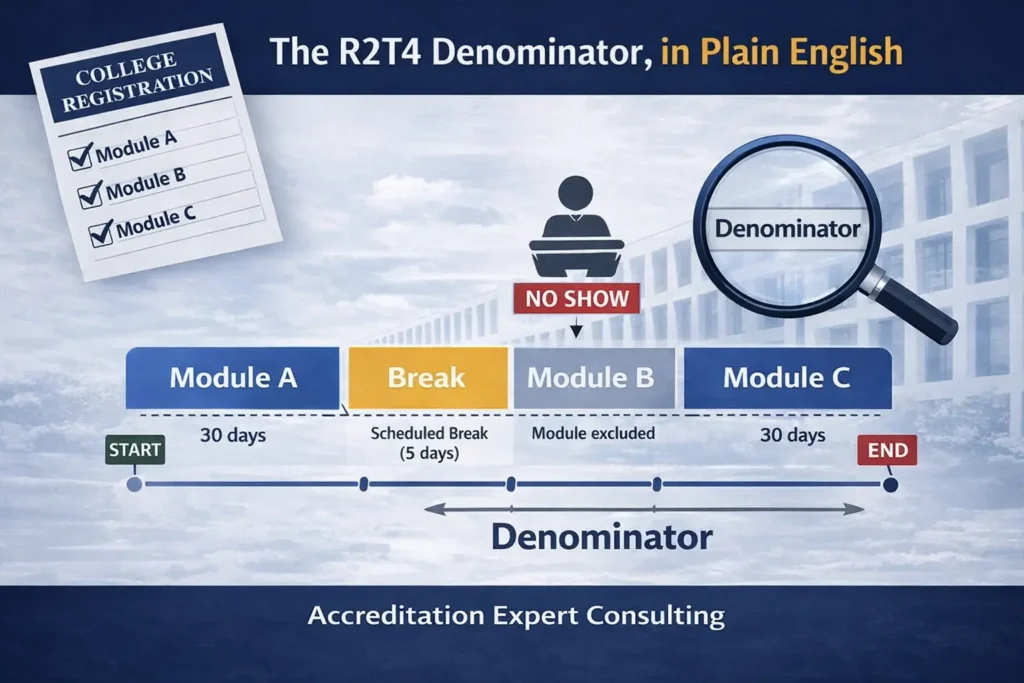
In an R2T4 calculation, you are essentially measuring how much of the applicable period the student completed. That “applicable period” is the denominator. In modular term-based programs, the denominator is where things get ugly because you are dealing with multiple start and end dates, breaks between modules, and students who enroll in Module B but never show up. Institutions revising modular calendars or redesigning academic structures should ensure alignment during curriculum development planning to prevent downstream compliance inconsistencies.
Separately, ED guidance clarifies how to count days in the period for R2T4 purposes, including that scheduled breaks of at least five consecutive days are excluded under certain conditions. U.S. Department of Education
The 2026 Denominator Rule, Stated Cleanly
Here’s the line you should treat like a compliance requirement, not a suggestion:
For a student in a program offered in modules, the student is scheduled to complete days in a module only when the student begins attendance in that module.
So, if a student registers for Module 2 but never begins attendance, those Module 2 days do not count in the denominator under the 2026 framework. Effective date: July 1, 2026.
What the Final Rule Is Trying to Eliminate
The Federal Register preamble is unusually blunt about the intent: ED is simplifying how schools determine whether days in a module are included by including them only if the student actually attends the module.

It also specifically calls out that schools should no longer need the older, complicated approach involving “freeze dates” or different handling depending on whether a student was a Pell vs. Direct Loan recipient.
ED is tired of inconsistent modular R2T4 files in which two competent people can read the same record and get two different denominators. They want something auditable: did the student begin that module?
Real Scenarios (What Changes in Practice)
These are concept examples to show how the denominator logic moves. Your actual results still depend on withdrawal date, institutional attendance requirements, scheduled breaks, and how your school documents academically related activity.
Scenario 1: Student Enrolls in Two 8-Week Modules, Starts Only Module 1
Setup: A student registers for Module 1 and Module 2 within the same term. They start Module 1, stop participating, and never begin Module 2.
2026 denominator impact: Module 2 days should not be counted in the denominator because the student never began attendance in Module 2.
Why it matters: Excluding Module 2 shortens the denominator, typically increasing the percentage completed and reducing the unearned aid to be returned. That is exactly why this change is operationally meaningful, not academic.
Compliance pressure point: Your school must be able to prove whether the student began Module 2. If your evidence standard is “they had access to the LMS,” you are inviting inconsistent files and bad decisions. This is a common pattern in online program compliance risks, where weak documentation and inconsistent engagement standards create defensibility problems in review.
Scenario 2: Student Starts Module 2, Then Withdraws Early
Setup: Same two-module term. Student completes Module 1, begins Module 2, participates briefly, then withdraws.
2026 denominator impact: Module 2 days now belong in the denominator because the student began attendance in Module 2.
Real-world note: This is where weak “module start” definitions cause damage. If one team calls Module 2 “begun” based on login and another requires an academically related activity, your denominator becomes staff-dependent. That is a finding waiting to happen.

Scenario 3: Student Stops Between Modules and Never Returns
Setup: Student completes Module 1, does not begin Module 2, and provides no confirmation of future attendance.
This scenario always exposes cross-functional weaknesses because it forces the institution to make a clean withdrawal determination. ED’s R2T4 modular guidance has long emphasized that schools may not delay R2T4 “just in case” a student returns, and explains how schools handle positive confirmation of future attendance and when a withdrawal must be “undone” if the student returns within the applicable timeframe.
2026 denominator impact: Under the new rule, Module 2 days should not be included in the denominator unless the student begins attendance in Module 2.
Why schools mess this up: They treat “registered for Module 2” as proof of intent to attend, but the rule pushes in the other direction: attendance counts.
Scenario 4: Student Adds a Later Module After Stopping
Setup: Student stops attending, then later adds (or re-adds) a later module inside the same payment period.
ED guidance notes that enrolling in a later module can function as positive confirmation of future attendance in certain modular contexts.
2026 denominator warning: If the student never actually begins the later module, you are back to the same denominator rule: days count only when attendance begins.
So the operational question becomes: are you tracking enrollment events, or are you tracking actual module start in a defensible way? Only one of those survives the review.
What You Should Update (Operationally, Not Just in a PDF Policy)
- Define “begins attendance in a module” in a way you can prove
The rule is simple. Your implementation won’t be, unless you standardize it. The best schools pick a definition that is measurable, repeatable, and reportable, then train everyone to use the same standard. - Make your SIS and LMS produce an auditable module-start report
If you cannot generate a report that shows module-by-module begin-attendance status with timestamps and evidence, your staff will fill the gap with manual judgment calls. Humans are not consistent. Auditors love that about us. - Align the withdrawal determination workflow with modular tracking
You still need a timely, documented process to identify withdrawals and process R2T4, including not delaying action “in case the student returns,” and handling reentry rules correctly.
The denominator rule will not save you from bad withdrawal timing or weak documentation. It just changes what days you count once you get to the calculation. - Treat scheduled breaks consistently
ED guidance has long addressed how scheduled breaks of at least five consecutive days can be excluded in the total calendar days calculation under certain conditions.
If different departments treat breaks differently (registrar calendar vs. FA calendar vs. program calendar), your denominator can drift.
Key Takeaways
- Starting July 1, 2026, days in a module count in the R2T4 denominator only if the student begins attendance in that module.
- ED explicitly describes this as a simplification intended to reduce inconsistent modular calculations and eliminate complex timing approaches.
- Your most significant risk is not the regulation text. Your risk is inconsistent evidence of module start across SIS, LMS, registrar, and financial aid records.
- Modular R2T4 failures usually result from weak documentation and mismatched systems, not math, a pattern frequently seen in school accreditation failure reasons.
Implementation Checklist
- Update written R2T4 procedures to reflect the 2026 modular denominator rule and its effective date. For an audio walkthrough, see our R2T4 Final Rule explained podcast.
- Create a formal institutional definition of “begins attendance in a module” and specify acceptable evidence sources (LMS activity type, instructor certification, attendance rosters, etc.).
- Build or validate a module-start status report that can be reproduced later (timestamped, tied to student and module, retained).
- Review your modular withdrawal workflows to ensure you do not delay required actions “just in case” a student returns, and that staff understand reentry/undo rules.
- Run test cases using real historical withdrawals: at minimum, “started Module 1 only,” “started Module 2,” “stopped between modules,” and “returned later.”
- Add a quality control step: a second reviewer should be able to recreate the denominator decision from the file without asking the first reviewer what they “meant.”
FAQ
When does the modular denominator rule take effect?
The modular R2T4 denominator rule takes effect on July 1, 2026, as finalized in the Federal Register rule.
What is the “2026 denominator rule” in one sentence?
For a program offered in modules, days in a module count as “scheduled to complete” only when the student begins attendance in that module.
Does “registered for Module 2” mean Module 2 counts?
Not under the 2026 denominator approach. The rule is tied to whether the student begins attendance in that module, not whether they were enrolled on paper.
Does this change remove the need to determine the withdrawal date correctly?
No. You still need a documented withdrawal determination process and timely R2T4 processing, including rules about not delaying action and how to handle return/reentry situations in modular structures.
What’s the most common failure point for modular R2T4?
Schools cannot consistently prove module start. Different teams use different evidence standards, so the denominator changes depending on who worked on the file. That inconsistency is exactly what ED is trying to shut down.
Do scheduled breaks matter in denominator calculations?
Yes. ED guidance states that scheduled breaks of at least 5 consecutive days may be excluded from the total days count, depending on how the student is scheduled across modules.
What should we have ready for an audit or program review?
A written definition of module begin-attendance, a reproducible report or evidence trail showing begin-attendance by module, and sample withdrawal files where another reviewer can trace your denominator decision and timeline without guesswork.
Final Word
This 2026 change is a gift, but only if you stop treating “module attendance” like a fuzzy concept. The regulation is trying to make the denominator auditable: attendance happened, or it didn’t.
If you want this to hold up under real review, treat it as a cross-functional implementation: financial aid, registrar, academics, and systems. If any of those groups is operating on assumptions rather than evidence, your R2T4 files will show it.
Accreditation Expert Consulting (AEC) can pressure-test your modular R2T4 workflow, your module-start documentation standard, and your reporting logic so your files are consistent and defensible before July 1, 2026.
About the Author
This article was prepared by the compliance team at AccreditationXpert, a U.S.-based higher education consulting firm specializing in Title IV compliance, accreditation strategy, regulatory risk mitigation, and institutional governance. AccreditationXpert supports institutions with R2T4 implementation planning, documentation standards, cross-functional workflow alignment, and defensible compliance practices.
Pre–July 1, 2026 Compliance Risk Review
The 2026 R2T4 denominator rule will expose inconsistencies in modular attendance tracking, withdrawal determination workflows, and SIS/LMS reporting alignment.
Before July 1, 2026, institutions should validate:
- Module begin-attendance documentation standards
- R2T4 denominator decision consistency
- Cross-departmental withdrawal workflows
- Scheduled break treatment alignment
AccreditationXpert provides structured modular R2T4 workflow reviews to help ensure Title IV files are consistent and defensible under program review.