By Dr. Ramin Golbaghi · Published August 24, 2025 · Updated October 2026

Only 31% of U.S. adults now say a college education is “very important,” a record low in Gallup’s polling and down from 70% in 2013. Yet the earnings gap is still there: in 2025, recent bachelor’s graduates working full time earned a median $60,000, against $40,000 for workers of the same age with only a high school diploma (Federal Reserve Bank of New York).
Both numbers matter to college leaders. From July 1, 2027, a federal earnings test will measure degree programs that take federal student aid against what high school graduates earn, and programs that fail it two years out of three lose access to federal Direct Loans. This article collects the current college ROI statistics, each with its source, and explains what institutions now have to document.
College ROI statistics for 2026
| Measure | Latest figure | Source |
|---|---|---|
| Adults who say college is “very important” | 31% (70% in 2013) | Gallup, October 2026 |
| Confidence in higher education (“a great deal” or “quite a lot”) | 38% (42% a year earlier) | Lumina Foundation-Gallup, July 2026 |
| Adults who say a four-year degree is worth it even with loans | 22% | Pew Research Center, May 2024 |
| Median full-time wage, ages 22-27 | $60,000 with a bachelor’s degree; $40,000 with a high school diploma (2025) | Federal Reserve Bank of New York |
| Unemployment, recent college graduates | 5.7%, against 4.1% for all workers (June 2026) | Federal Reserve Bank of New York |
| Underemployment, recent college graduates | 42% (June 2026) | Federal Reserve Bank of New York |
| Average tuition and fees, all institutions | $6,608 in 2003-04 to $14,966 in 2023-24; about 36% higher after inflation | NCES Digest, Table 330.10 |
| Published tuition and fees, 2025-26 | $11,950 at public four-year (in-state); $45,000 at private nonprofit four-year | College Board, November 2025 |
| Federal student loan portfolio | More than $1.7 trillion, 42.3 million recipients (June 30, 2026) | Federal Student Aid |
| Undergraduate enrollment | 15.5 million in spring 2026 (+1.3%); undergraduate certificates grew fastest (+10.2%) | National Student Clearinghouse, June 2026 |
Figures checked October 10, 2026. Different sources measure student debt differently; these numbers are not meant to be added together.
National averages don’t tell you how your own programs will do. The federal earnings test looks at each program’s graduates. If you want to know where your programs stand before the first results are published, start with an introductory meeting.
Listen: is higher ed still worth it? (podcast)
In episode 13 of Accreditation and Beyond (August 2025, 6 minutes), Dr. Ramin Golbaghi and Sam Askari take the question presidents and founders keep asking them: is higher ed still worth it? They cover five points:
- Enrollment. Why undergraduate enrollment fell for a decade, more steeply for men than for women, and why small private colleges and community colleges felt it most. The latest numbers, state by state, are in our guide to the enrollment cliff.
- Debt. Students now ask what they are paying for and what outcomes they will get. A school that can’t answer with placement rates and skills alignment loses them to bootcamps and certificate programs.
- Transparency. Many college websites bury the total cost, the average time to completion and graduate outcomes. Accreditors ask whether prospective students can understand what they are buying.
- Reinvention. Close underperforming programs, add short-term credentials and hybrid formats for working adults, and document those decisions before the next site visit.
- Accreditation as strategy. Use the annual report, outcome data and strategic plan to show the accreditor that the institution is acting on its data.
Why the ROI question matters to colleges now
Declining confidence in the degree
Confidence in higher education fell to 38% in the 2026 Lumina Foundation-Gallup survey, from 57% in 2015. Among adults with little or no confidence, the top reasons were political agendas (31%), cost (30%) and poor preparation for work (25%). Two of those three are about value, and a college can answer them with its own data.
What students now expect
Today’s students want:
- Clear career pathways
- Measurable learning outcomes
- Flexible, skills-focused credentials
- Transparent data on costs, earnings, and placement rates
Meeting those expectations takes curriculum design, outcome data and records the accreditor can check, which is where accreditation consulting for colleges comes in.
Who is asking colleges to prove value
Accreditors
Accreditors judge institutional effectiveness through student outcomes. The Accrediting Commission of Career Schools and Colleges (ACCSC), for example, requires a school to provide student achievement outcomes before it can receive initial accreditation. In practice, schools should:
- Define and track student learning outcomes
- Align course objectives with workforce competencies
- Use data dashboards to monitor academic ROI
State approval agencies
Depending on the state, an application for a new program may ask for:
- Labor market alignment evidence
- Employer support letters
- Projected student earnings data
- Cost-benefit justifications for prospective students
Learn how our state approval support works.
The federal government: the new earnings test
The One Big Beautiful Bill Act (Public Law 119-21, July 2025) added an earnings test to the Higher Education Act, and the U.S. Department of Education’s final rule (91 FR 40136, July 1, 2026) puts it into effect on July 1, 2027. How it works:
- It covers undergraduate degree, graduate degree and graduate certificate programs.
- Program completers who are working are compared with working adults aged 25 to 34 who have only a high school diploma. For graduate programs, the comparison group holds only a bachelor’s degree.
- Earnings are measured in the fourth tax year after completion, using federal data.
- A program that fails in two out of any three years loses access to federal Direct Loans. Students must be warned, and must acknowledge the warning, before aid is disbursed.
- Undergraduate certificate programs stay under the gainful employment rules, which now use the same earnings comparison.
Until the new rule replaces it, the 2023 Financial Value Transparency and Gainful Employment (FVT/GE) rule still applies. Federal Student Aid has set January 15, 2027 as the reporting deadline for the 2024, 2025 and 2026 cycles (GENERAL-26-49), and the Department plans to publish program data in 2027. Each program’s debt and early earnings are already public in the College Scorecard.
A new definition of institutional value
From inputs to outcomes
Old metrics like student-faculty ratios and campus size are giving way to:
- Graduate employability
- Earnings vs. debt ratios
- Skill mastery and stackable credentials
- Student satisfaction linked to measurable gains
Students compare programs like investors

Prospective students now act like investors, comparing programs based on:
- Cost-per-credit
- Internship and job placement rates
- Alumni testimonials and salaries
- Program accreditation status
If accreditation status is one of the things students compare, see how initial accreditation works.
How colleges can show program value
1. Review the program portfolio
- Audit programs for relevance to high-demand fields
- Map learning outcomes to industry certifications
- Build faster pathways to graduation
- Close or redesign programs whose graduates earn less than the federal benchmark, before the earnings test does it for you. Our curriculum development services cover program redesign against accreditor standards
- Add short-term credentials and hybrid formats for working adults, where the labor market data supports them
2. Publish the numbers students look for
- If accreditation status is one of the things students compare, see how initial accreditation works.
- Publish earnings vs. cost comparisons
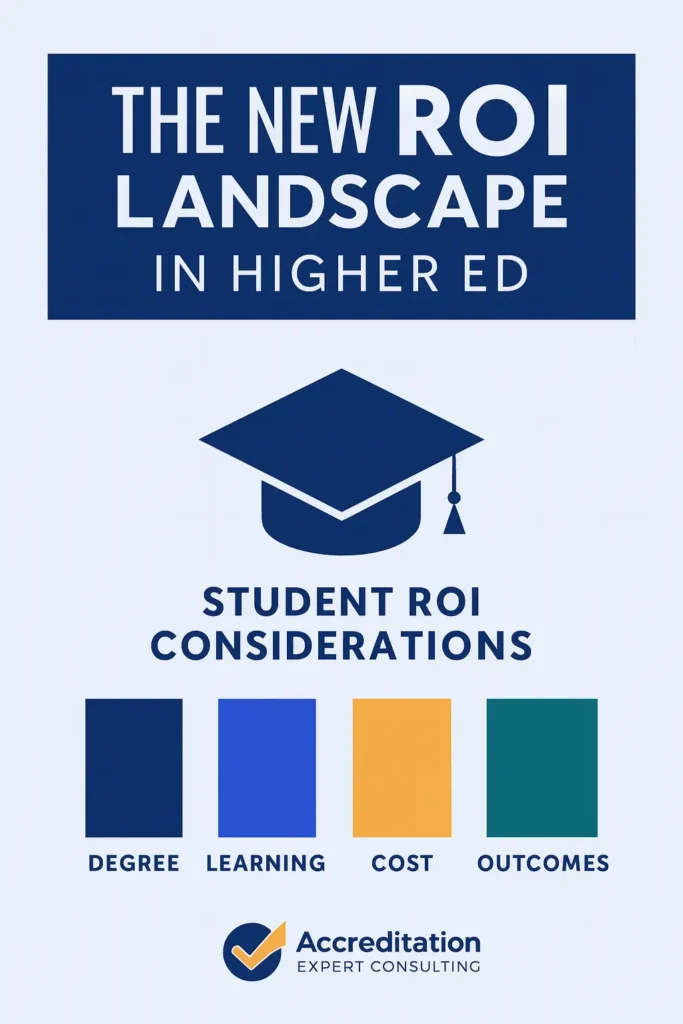
- Visualize ROI with infographics, not just text
- Segment data by program and population
Click here to download the Beyond Grades Assessment Toolkit for evaluating and communicating ROI effectively.
3. Involve students and alumni
- Collect and act on alumni outcome data
- Include student input in program reviews
- Make career services a core academic partner
Three more habits help, and none of them needs a new budget line:
- Ask graduating students what they feel confident they learned and what still feels unclear, then change next term’s courses based on the answers. Mid-term check-ins do the same job during the term.
- Bring alumni back as mentors, guest speakers and admissions volunteers. A graduate who stays involved is evidence of value that a prospective student can talk to.
- Treat advising as retention work, especially for first-generation and working adult students. An advisor who helps a student build one real connection with a faculty member does more for persistence than a course schedule.
4. Document it for the accreditor
Every program change, closure and new credential should show up in the self-study, the annual report and the strategic plan, with the outcome data behind it. Do it before the next site visit, not during it. If a self-study is coming up, see our self-study report preparation.
Frequently Asked Questions
How can smaller colleges compete on ROI without major endowments?
Focus on outcomes. Highlight career placement, alumni impact, and program-specific ROI. Use data visualization to make the numbers easy to read.
Do accreditors penalize schools with low graduate earnings?
Accreditors judge outcomes against their own standards, and a school that does not assess and improve its outcomes can receive findings. Low earnings now carry a separate federal consequence: under the earnings test, a program can lose Direct Loan eligibility.
What types of data should be shared with students during recruitment?
Job placement rates, median graduate salaries, loan repayment rates, and skill-based outcomes aligned with real roles. Program-level debt and earnings from the College Scorecard are a public starting point.
Can ROI be improved without cutting tuition?
Yes. Shorten the time to completion, build industry certifications into the program, and align the curriculum with fields that are hiring.
What are the top mistakes schools make when reporting ROI?
Using outdated data, hiding poor outcomes, or failing to contextualize program-level metrics.
Is college still worth it in 2026?
For most graduates, the earnings gap says yes: in 2025, recent bachelor’s graduates working full time earned a median $60,000, against $40,000 for high school graduates of the same age (Federal Reserve Bank of New York). It depends on the program, though. Recent graduates also face 5.7% unemployment and 42% underemployment (June 2026), and earnings differ widely by field, which is why the federal earnings test now looks at each program.
What is the federal earnings test for college programs?
From July 1, 2027, degree programs and graduate certificates are compared with the median earnings of working adults aged 25 to 34 with only a high school diploma, or only a bachelor’s degree for graduate programs. A program that fails in two of any three years loses federal Direct Loan eligibility.
Talk to us about your program outcomes
If you are not sure how your programs will look under the earnings test, or what your accreditor will ask about outcomes at the next review, book an introductory meeting.
About the author
Dr. Ramin Golbaghi is the Founder and CEO of Accreditation Expert Consulting.He founded and led a private postsecondary school,as its owner, ACCSC institutional accreditation, Title IV certification, VA education benefits approval, WIOA/I-TRAIN workforce eligibility and SEVP certification.

Sources
- Gallup, “Record-Low 31% Say College Education Is ‘Very Important'” (October 1, 2026); Lumina Foundation-Gallup, confidence in higher education (July 13, 2026)
- Pew Research Center, “Is College Worth It?” (May 23, 2024)
- Federal Reserve Bank of New York, “The Labor Market for Recent College Graduates” (updated August 2026)
- NCES, Digest of Education Statistics, Table 330.10; College Board, Trends in College Pricing and Student Aid 2025
- National Student Clearinghouse Research Center, fall 2025 and spring 2026 enrollment reports
- Federal Student Aid, Electronic Announcements GENERAL-26-57 and GENERAL-26-49
- U.S. Department of Education, final rule, 91 FR 40136 (July 1, 2026); 20 U.S.C. 1087d(c)
- U.S. Department of Education, College Scorecard data (updated June 10, 2026)