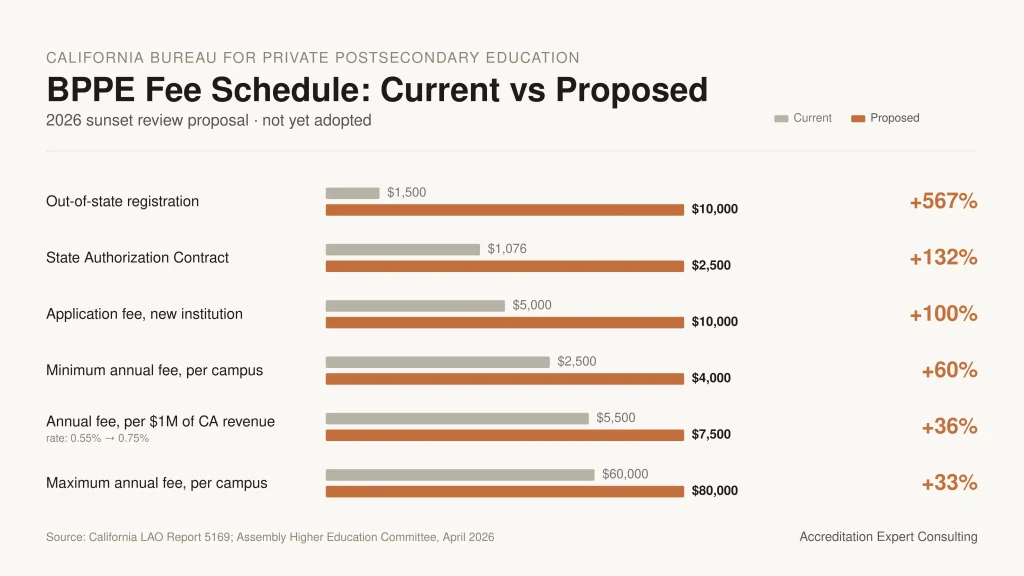
California’s Bureau for Private Postsecondary Education has proposed raising every fee on its schedule. The annual fee would go from 0.55% to 0.75% of California student revenue, a 36% increase in the amount billed. The application fee for a new institution would double to $10,000, and out-of-state registration would go from $1,500 to $10,000. Nothing is law yet. The Bureau’s fund is projected insolvent in 2027-28, so budget as though it will be.
This page covers what is changing and what each line costs. If you are earlier than that and still working out how to get BPPE approval to operate in California, start there instead. For the operational side, inspections, Notices to Comply, substantive changes and record retention, see our BPPE compliance guide for California institutions.
Status: Proposed. Not adopted, no effective date set. · Last updated: August 31, 2026 · Written by Dr. Ramin Golbaghi, Founder, Accreditation Expert Consulting.
Building next year’s budget and not sure what to put in it? Call +1 (833) 232-1400 or ask us to model it against your enrollment.
The proposed BPPE fee increase, line by line
| Fee | Current | Proposed | Change |
|---|---|---|---|
| Out-of-state registration | $1,500 | $10,000 | +567% |
| State Authorization Contract | $1,076 | $2,500 | +132% |
| Application fee, new institution | $5,000 | $10,000 | +100% |
| Minimum annual fee per campus | $2,500 | $4,000 | +60% |
| Annual fee, share of California student revenue | 0.55% | 0.75% | +36% |
| Maximum annual fee per campus | $60,000 | $80,000 | +33% |
| AccreditationXpert.com+1 (833) 232-1400 · Free Consultation | |||
Three of those six lines need context that the percentage does not give.
The BPPE application fee has not moved since 2009
Seventeen years of held pricing means the correction arrives all at once, in one budget year, rather than in increments anyone planned for. At $10,000, a rejected application stops being a cheap mistake to make twice. The reasons BPPE rejects an application are the same as they were last year. What doubles is the price of hitting one, which changes the arithmetic on having the file read before BPPE reads it.
Eight years since the last annual fee change
The current rate came out of the 2016 sunset review and was fully implemented by July 1, 2018. The mechanism now is the same one: a sunset review produces a fee schedule, the Legislature approves it, implementation follows over a defined period.
Out-of-state registration is the outlier
Going from $1,500 to $10,000 is close to a seven-fold increase, and it falls on institutions that have no California campus at all. If you operate anywhere else in the country and enroll California residents online, that is the line to model first, and it is the one most out-of-state schools have never had to think about.
Why BPPE is raising fees: the fund runs out in 2027-28
BPPE is funded by a special fund rather than the General Fund, and that fund has spent more than it collected every year since 2014-15.
California’s Legislative Analyst’s Office projects the fund goes insolvent in 2027-28, landing somewhere between $2.5 million and $6.3 million negative. That projection holds under current law and under the Governor’s proposal alike. The LAO recommends that the Legislature reject a General Fund bailout and fix the structural deficit through the sunset review instead, by approving fee increases and possibly tying the maximum annual fee to inflation.
That last detail matters more than it looks. A maximum fee indexed to inflation does not need another sunset review to rise again. If it passes in that form, the $80,000 ceiling becomes a moving one, and the eight-year gap between adjustments disappears as a planning assumption.
What the BPPE fee increase costs your institution
Start with your own revenue. The percentages come second.
The annual fee is assessed on each campus’s total revenue from California students. Moving the rate from 0.55% to 0.75% raises the fee itself by 36%. It is not a 0.2% increase.
| California student revenue | Fee at 0.55% | Fee at 0.75% | Annual difference |
|---|---|---|---|
| $400,000 | $2,500(minimum applies) | $4,000 (minimum applies) | +$1,500 |
| $500,000 | $2,750 | $4,000 (minimum applies) | +$1,250 |
| $1,000,000 | $5,500 | $7,500 | +$2,000 |
| $2,500,000 | $13,750 | $18,750 | +$5,000 |
| $5,000,000 | $27,500 | $37,500 | +$10,000 |
| $10,000,000 | $55,000 | $75,000 | +$20,000 |
| $11,000,000+ | $60,000 (capped) | $80,000 (capped) | +$20,000 |
| AccreditationXpert.com+1 (833) 232-1400 · Free Consultation | |||
Two structural effects fall out of that table. Neither one comes from the rate change itself.
Where the minimum fee bites, and how hard
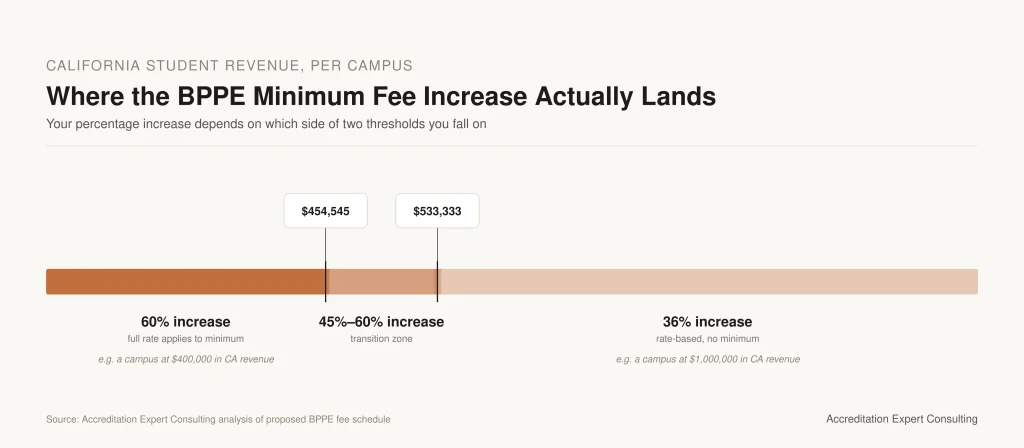
The current $2,500 minimum governs any campus below $454,545 in California student revenue. The proposed $4,000 minimum governs any campus below $533,333. Those two thresholds are not the same, which produces three different outcomes:
- Below $454,545, you pay the minimum now and you would pay the minimum after. Your increase is the full 60%.
- Between $454,545 and $533,333, you pay the rate now and you would pay the minimum after. A campus at $500,000 goes from $2,750 to $4,000, a 45% increase.
- Above $533,333, the rate governs both ways and your increase is 36%.
Multi-campus operators multiply everything
The minimum and the maximum are both assessed per campus. Three campuses at the minimum is $12,000 a year. Today that same operator pays $7,500.
If you run more than one location, or you sit anywhere near $500,000 in California revenue, the difference is worth modeling against your actual enrollment before your board meeting, not after it.
The BPPE sunset date: January 1, 2027
BPPE’s authorizing statute carries a sunset date of January 1, 2027. The Legislature is deciding now whether the Bureau continues and in what form, through the same review that carries the fee proposal.
The practical read for a school owner has nothing to do with the regulator disappearing. It is that a Bureau under legislative examination is producing a written record of its own oversight work, and your file is part of what it counts.
The sunset background paper runs to 38 numbered issues. Four of them point directly at institutions:
- Ownership and management history. The Bureau can already deny an application over prior violations. The paper flags a gap: nothing currently stops individuals involved in an improper closure from opening somewhere else.
- Accrediting agency documents. BPPE cannot currently request information from an accreditor about an institution that is still pursuing accreditation, only about approved ones. The recommendation is to close that gap.
- Application verification. The Bureau is being asked to independently verify applicant information rather than accept it as submitted.
- Revenue validation. The Bureau currently relies on self-reported revenue with no verification. It has been asked to assess what verifying it would take.
The last one connects straight back to the fee. A fee assessed on self-reported revenue, in a system being told to start verifying revenue, is a compliance exposure as well as a cost.
The STRF pause and what it still requires
The Student Tuition Recovery Fund assessment is currently paused, because the fund has reached its $25 million threshold. Under the statutory mechanism, assessments resume when the fund falls below $20 million.
The rate is zero. The obligation is not.
Three problems show up in the files of institutions that treated the pause as a repeal:
- STRF disclosure language removed from enrollment agreements or catalogs. The disclosure requirement under Title 5 of the California Code of Regulations, Section 76215, does not pause with the rate.
- Quarterly filing habit dropped. Schools that kept filing at zero will restart smoothly. The ones that stopped have to rebuild a process under a deadline.
- No trigger monitoring. Nobody is watching the fund balance, so the restart arrives as a surprise.
STRF collection, disclosure wording and quarterly mechanics are covered in full in our STRF compliance guide for California schools.
If your enrollment agreement was revised during the pause, have someone check the STRF language before your next inspection. It is a fifteen-minute review.
What a BPPE fine costs today
While the fee question is unresolved, the penalty side is already in force:
- A citation can carry a fine of up to $5,000
- Unlicensed activity carries fines up to $100,000
- Cases referred to the Attorney General carry cost-recovery exposure on top of the fine
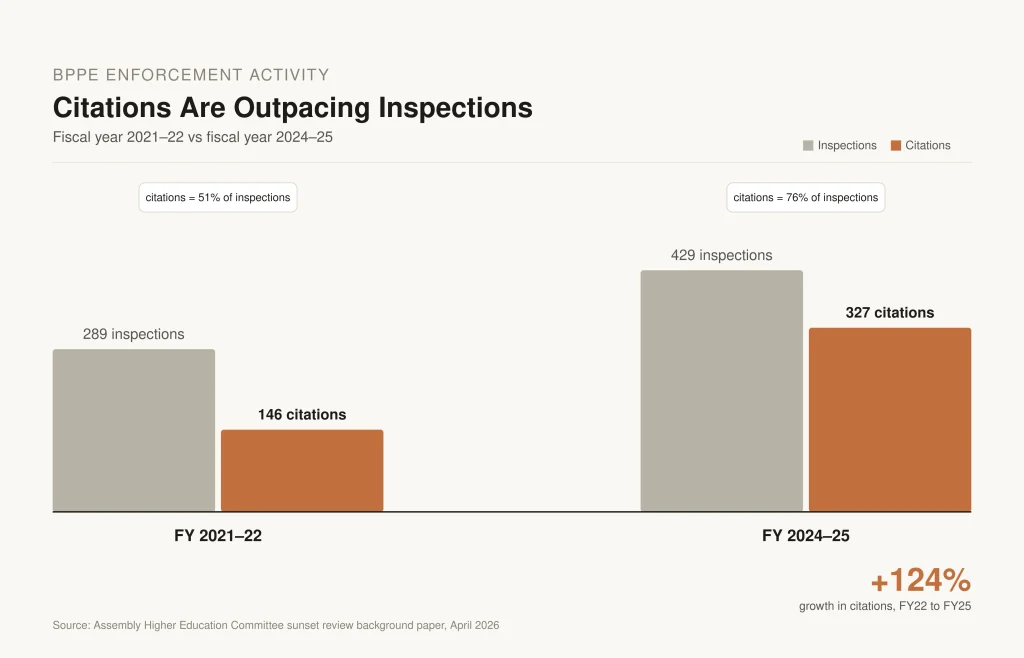
Enforcement volume is climbing faster than inspection volume. The Assembly Higher Education Committee’s April 2026 background paper records 327 citations in FY 2024-25 against 146 in FY 2021-22, a 124% increase over three years. Inspections over the same period rose from 289 to 429, about 48%.
Put those two rates side by side. Citations grew more than twice as fast as inspections, which means a larger share of inspections now ends in a citation rather than a correction on the spot. The margin for fixing something during the inspection is narrower than it was three years ago.
What an inspection finding looks like, and how a Notice to Comply is answered, is covered in the inspections section of our BPPE compliance guide. If a citation turns into a denial instead of a correction, the reasons BPPE rejects an application apply just as much to an existing institution as to a new one.
What federal cuts mean for California oversight
The sunset review records that U.S. Department of Education staffing has been cut by close to half and its San Francisco regional office closed, alongside federal moves affecting which accrediting agencies keep recognition.
It is tempting to read federal retrenchment as less scrutiny overall. In California the Committee’s own recommendation points the other way: BPPE may need expanded capacity to fill the oversight gaps the federal government is leaving. Expanded capacity is funded by fees.
What California schools should do before the decision lands
Five steps, in order, none of which requires knowing the outcome:
- Put the higher number in next year’s budget. Model at 0.75% with the $4,000 minimum. If it doesn’t pass, you’re over-provisioned by a few thousand dollars. If it does and you didn’t, you’re explaining a variance to your board.
- Find your threshold before you assume 36%. Below $454,545 in California student revenue your increase is 60%. Between $454,545 and $533,333 it lands somewhere between 45% and 60%. Above that, 36%.
- Count your campuses. Minimum and maximum are per campus, and multi-location operators multiply the whole change.
- Check that your reported revenue is defensible. The Bureau has been asked to start validating it. Whatever you file should reconcile to your financial statements without explanation.
- Restore any STRF language removed during the pause, and keep filing quarterly at zero.
If you want the arithmetic done against your real enrollment, send us your California revenue by campus and we’ll model both scenarios. If your numbers land in the flat part of the schedule, the model will show that in an afternoon and there is nothing further to buy.
Frequently asked questions
How much is BPPE increasing its fees?
The annual fee would go from 0.55% to 0.75% of California student revenue. The per-campus minimum rises from $2,500 to $4,000 and the maximum from $60,000 to $80,000. New-institution applications go from $5,000 to $10,000, out-of-state registration from $1,500 to $10,000, and the State Authorization Contract from $1,076 to $2,500.
When does the BPPE fee increase take effect?
No date is set. The proposal is awaiting legislative approval through the 2026 sunset review. The comparable 2016 review produced a fee schedule that was fully implemented by July 1, 2018.
Why is BPPE raising fees?
Its special fund has spent more than it collected every year since 2014-15, and the Legislative Analyst’s Office projects insolvency in 2027-28, between $2.5 million and $6.3 million negative. The application fee has not changed since 2009.
How much more will my school actually pay?
It depends on where your California student revenue falls. Below $454,545 the minimum governs and your increase is 60%. Above $533,333 the rate governs and your increase is 36%. Between those two figures you move from a rate-based fee to the new minimum, which works out to roughly 45% at $500,000 in revenue.
What is the BPPE sunset date?
January 1, 2027. The Legislature is reviewing whether and how the Bureau continues, in the same process carrying the fee proposal.
Is the STRF assessment still zero?
Yes. Assessments are paused because the fund reached its $25 million threshold, and resume when it falls below $20 million. The disclosure and filing obligations continue regardless of the rate.
Do we still need STRF language in our enrollment agreement while assessments are paused?
Yes. The disclosure requirement under Title 5 of the California Code of Regulations, Section 76215, is separate from the assessment rate and does not pause with it.
How much is a BPPE fine?
Up to $5,000 for a citation and up to $100,000 for unlicensed activity, plus possible cost recovery on cases referred to the Attorney General.
Does this affect schools outside California?
Yes. Out-of-state institutions that register to enroll California residents would go from $1,500 to $10,000, the largest proportional increase anywhere on the schedule.
Work out what this means for your institution
The fee change is arithmetic. Whether your revenue reporting survives verification, and whether your STRF language survived the pause, are questions of a different kind.
Where we usually start on this:
- Fee modeling at both rates, by campus, against your actual California revenue
- A revenue-reporting review, so what you file reconciles to your financials
- STRF disclosure check on current enrollment agreements and catalog
- Board-ready summary of what changes and what it costs
Accreditation Expert Consulting 20855 Ventura Blvd, Ste 10-A, Woodland Hills, CA 91364 Serving California institutions from Los Angeles County, and institutions in all 50 states +1 (833) 232-1400 · Request a consultation
About the author

Dr. Ramin Golbaghi founded and led a private postsecondary institution in Southern California, and personally obtained every approval it operated under:
- BPPE approval to operate
- ACCSC institutional accreditation
- Title IV certification
- VA education benefits approval
- WIOA/I-TRAIN workforce eligibility
- SEVP certification
More than 400 deficiency and corrective-action responses across the founder’s and the team’s careers.
Accreditation Expert Consulting provides educational, accreditation and regulatory consulting services. AEC does not accredit institutions, issue state authorization, certify Title IV eligibility, approve VA education benefits, approve workforce funding, or grant SEVP certification. Final decisions are made by the applicable government agencies, accrediting organizations and regulatory authorities. Consulting services do not guarantee approval or accreditation.