By Dr. Ramin Golbaghi · Published June 17, 2025 · Updated October 2026
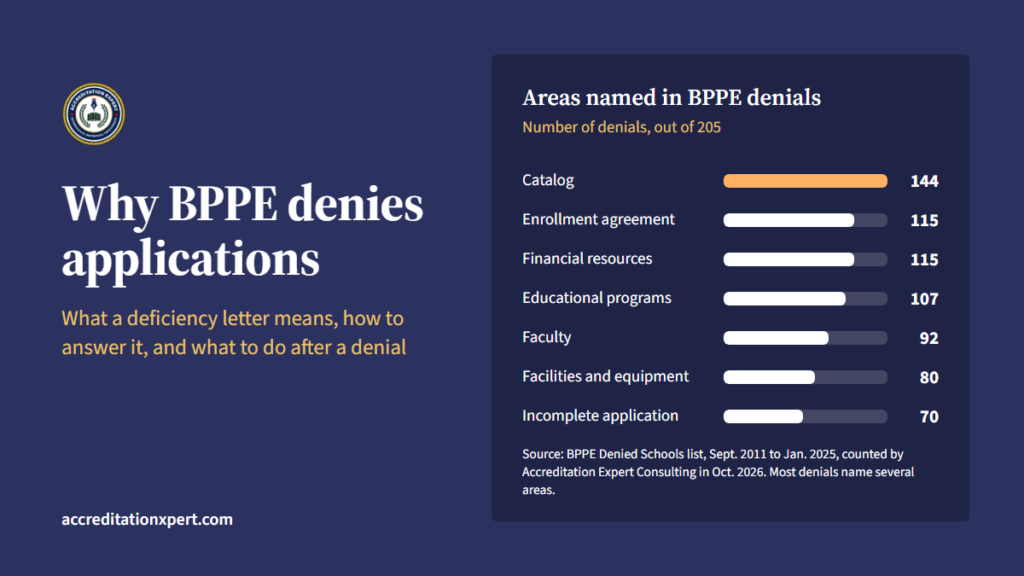
California law requires the Bureau for Private Postsecondary Education (BPPE) to post every final denial of an approval to operate on its website, with the reasons. Each entry names the parts of the application that fell short. Of the 205 denials on that list, dated September 2011 to January 2025, 144 name the catalog.
This guide is for owners and administrators who have applied for BPPE approval to operate, or who have a deficiency letter or a denial on the desk. It explains what each letter means, which dates matter, how to answer, and what BPPE cites most often, grouped into 12 areas with the rule behind each one. The six episodes of our podcast series Why Schools Get Denied are further down the page.
The short answer. BPPE must deny an application that does not meet the minimum operating standards of the California Private Postsecondary Education Act. Before a decision, an analyst reviews the file and, if it falls short, sends a deficiency letter listing what has to change. The denials on BPPE’s list usually cite several documents at once. The catalog, the enrollment agreement, financial statements, program descriptions and faculty files lead the count.
Deficiency letter or denial: which one do you have?
The letters arrive at different points in BPPE’s review. Each one needs a different response.
| Letter | When it arrives | What it means | What happens next |
|---|---|---|---|
| Incomplete-application notice | Soon after BPPE receives the application | Documents or information are missing. BPPE has not started its compliance review | The file waits for the missing items. If it is still incomplete one year after BPPE received it, or one year after the notice, whichever is later, it is abandoned and the fee is forfeited |
| Deficiency letter | After an analyst has reviewed the file against the minimum operating standards | Named items fall short of a standard. The letter explains what is needed | BPPE’s application workshop guide says applicants have about 30 days to respond. The date in your letter is the one that counts. The analyst then reviews the response and can send another letter |
| Conditional authorization to operate | When only minor deficiencies remain and the institution is substantially in compliance | A limited period to correct them, which BPPE can extend once | If the deficiencies are still there when it expires, the application is deemed denied |
| Denial | When the application does not satisfy the minimum operating standards | A decision. The notice must state the reasons | You can request a hearing or file a new application. Once the denial is final, BPPE lists the institution on its Denied Schools page |
You received a deficiency letter: what to do now
- Find the response date and work backward. Put it on the calendar of everyone who will touch the response, and set your own deadline a week earlier.
- Read every item before anyone writes. Sort the items into three piles: a document that is missing, a document that has to be rewritten, and a policy or practice that has to change before any document can describe it.
- Fix the item everywhere it appears. A refund policy corrected in the catalog and left alone in the enrollment agreement creates a new deficiency. Read the catalog, the enrollment agreement, the School Performance Fact Sheet, the website and your written policies side by side.
- Answer every item. An item you skip stays open and costs another round. If you disagree with one, say so in a neutral tone and cite the standard and the evidence. In episode 4 of our podcast, Dr. Golbaghi and Sam Askari describe the deficiency letter as a structured request for correction. Arguing with it rarely helps.
- Submit before the date and keep proof of delivery. If one document cannot be ready in time, write to the analyst before the date, say which item it is and when it will arrive.
A deficiency letter comes with a date. If you want help drafting the response, book an introductory meeting and bring the letter. We’ll go through what the response involves and how we would work on it with you. Across Dr. Golbaghi’s and the team’s careers, that work includes more than 400 deficiency, compliance and corrective-action responses. See how our BPPE consulting service works.
How to structure a deficiency response
The analyst reads your response against the letter, one item at a time. Build it the same way. In episode 4, Dr. Golbaghi and Sam Askari describe the format: each deficiency gets its own labeled section with an explanation, a reference to the standard, and the corrected document attached.
A response matrix at the front keeps it in order:
| Column | What goes in it |
|---|---|
| Item | The item number and BPPE’s wording from the letter |
| Standard | The Education Code or regulation section the item cites |
| What changed | One or two sentences on the correction |
| Where to find it | Each corrected document, with page numbers in the resubmitted file |
| Also updated | Every other document that repeats the same content, such as the catalog, enrollment agreement, School Performance Fact Sheet or website |
Number every page of the response. The analyst should never have to search for a fix. Send final documents, signed and dated where the form calls for it. The application asks for exemplars of student agreements, so send finished samples.
BPPE denied the application: your options
A denial notice must include a statement of the reasons. Read those reasons against the 12 areas below before you decide what to do next.
- Request a hearing. Denial proceedings follow California’s Administrative Procedure Act. Check the notice for how and when to request a hearing, and put that date on the calendar the day the letter arrives. A hearing is a formal legal proceeding. Talk to a California lawyer who handles administrative cases. We are consultants, and we do not give legal advice.
- File a new application. We found no waiting period in the Act or BPPE’s regulations before a new application for approval to operate (checked October 2026). Confirm with BPPE before you file. A new application means a new fee, since BPPE fees are non-refundable, and a new review. Fix every area in the statement of reasons first. Our article on the BPPE fee increase in 2026 covers the fee schedule.
- If a renewal was denied. An institution that appeals the denial of a renewal may keep operating during the appeal. It must give every current and prospective student a BPPE-approved written statement that renewal was denied and that it is appealing.
- Check whether you need approval at all. Some institutions are exempt. Our California page sets out which BPPE route applies and how exempt status is verified.
- Do not enroll students in the meantime. A non-exempt institution cannot open, conduct or do business in California without an approval to operate.
One more thing to know: a denial is public. BPPE’s Denied Schools page shows the institution’s name, the dates and the deficiency areas, and its oldest entries go back to 2011.
The 12 areas behind BPPE denials, by the numbers
BPPE’s Denied Schools page names the deficiency areas behind each denial, using the section names of the application. We counted them on October 10, 2026. The page lists 205 denials from September 2011 to January 2025: 144 initial applications and 61 renewals. Most entries name several areas, so the shares add up to more than 100%. The page does not say which deficiency decided a case.
| Area named in the denial | All denials (of 205) | Initial applications (of 144) |
|---|---|---|
| Catalog | 144 (70%) | 103 |
| Enrollment agreement or exemplars of student agreements | 115 (56%) | 78 |
| Financial resources, statements or stability | 115 (56%) | 58 |
| Educational programs or education quality | 107 (52%) | 98 |
| Faculty | 92 (45%) | 85 |
| Facilities and equipment | 80 (39%) | 71 |
| Incomplete application | 70 (34%) | 48 |
| Organization and management | 50 (24%) | 45 |
| Records or recordkeeping | 48 (23%) | 41 |
| Instruction and degrees offered | 45 (22%) | 41 |
| Library and other learning resources | 34 (17%) | 29 |
| School Performance Fact Sheet | 29 (14%) | 16 |
| Mission and objectives | 26 (13%) | 17 |
| Advertising | 25 (12%) | 19 |
| Ownership | 25 (12%) | 16 |
| Annual report | 19 (9%) | 7 |
| Student Tuition Recovery Fund (STRF) | 13 (6%) | 1 |
| Accreditation plan for degree programs | 9 (4%) | 7 |
Counted by AEC from BPPE’s Denied Schools page on October 10, 2026, with one exact duplicate row removed. Labels are grouped by keyword. The list has grown more slowly in recent years, with 26 entries dated 2020 or later against 34 in 2016 alone.
The catalog is missing required content
The catalog appears in 144 of the 205 denials, more than any other area. California treats it as a disclosure document. The Education Code lists 16 items a catalog must contain before a student enrolls, and BPPE’s regulations add more, along with a yearly update.
Start with the statements the law spells out. The current law gives four statements word for word, including one about BPPE’s Office of Student Assistance and Relief, and a catalog built from an older template may have only three. The notice on transferability of credits also has fixed wording. An unaccredited institution that offers degrees has to disclose the known limitations of those degrees.
Episode 4 of our podcast makes a point worth checking first. The required content is often in the catalog already, but buried, worded inconsistently or not labeled the way BPPE looks for it. Build a crosswalk with every required item, the page that answers it and the exact wording. Then read the refund policy, program hours and charges against the enrollment agreement.
The enrollment agreement does not match the catalog
The enrollment agreement shows up in 115 denials, 40 of them under the application heading “Exemplars of Student Agreements.” The Education Code sets what it must contain:
- the program and its total clock or credit hours
- the schedule of total charges, with STRF obligations marked non-refundable
- three charge lines in underlined capital letters on the signature page
- the “STUDENT’S RIGHT TO CANCEL” disclosure with the refund policy
- the transferability notice from the catalog
- the statement and initial line confirming the student received the catalog and the School Performance Fact Sheet
- the statements that questions and complaints may go to BPPE
BPPE’s regulations add the period covered, start and completion dates, and itemized charges. BPPE’s STRF statement belongs on both the enrollment agreement and the catalog, even while the STRF assessment is paused.
Episodes 5 and 7 describe the usual failure: a template copied from another school, with a refund policy or graduation requirements that contradict the catalog. BPPE asks for exemplars, so send complete, final samples.
Financial statements do not show enough resources
Financial resources, statements or stability appear in 115 denials, and in 57 of the 61 renewal denials. BPPE’s standard is practical: the institution needs enough money to deliver every program it promises, give enrolled students a reasonable chance to finish, pay refunds and cover its operating bills. Our BPPE compliance guide explains the year-end test BPPE applies after approval.
For the application, that means current financial statements reviewed by an independent CPA: a balance sheet, an income statement and a cash flow statement. Statements that are out of date or prepared in-house do not meet the requirement.
Episode 6 describes what falls short: a bookkeeping export or a bank statement in place of reviewed statements, and no explanation of the funding model. Say where working capital comes from and what happens if the first cohort is smaller than planned. A parent company’s resources can count if BPPE’s conditions for that are met.
Program descriptions and curriculum are too thin
Educational programs or education quality appear in 107 denials, and in 98 of the 144 initial applications. For each program, the application asks for admissions and graduation requirements, the method of instruction and the occupations it leads to. It also asks for the competencies students will gain, the faculty and equipment needed and a three-year enrollment projection. Every course needs a syllabus with the seven elements BPPE’s regulations list, from educational objectives and length to required textbooks and how skills are measured.
Episode 7 gives an example of what fails: a description that says a course “helps students gain foundational knowledge in business.” That reads like marketing copy. Spell out the competencies, the clock or credit hours and how each objective is assessed. If a program runs online, hybrid or in person, or in more than one language, describe each version. Episode 8 adds labor-market alignment: if a program prepares students for a job, show that employers are hiring for it.
Course materials have to be designed or organized by duly qualified faculty, so say who wrote the curriculum and why that person is qualified. Our curriculum development service builds programs and syllabi to these requirements.
Faculty files do not prove qualifications
The analyst reads your response against the letter, one item at a time. Build it the same way. In episode 4, Dr. Golbaghi and Sam Askari describe the format: each deficiency gets its own labeled section with an explanation, a reference to the standard, and the corrected document attached.
The application also asks how many faculty each program needs and what qualifications they hold, with job duties for every faculty and administrative position. Episode 5 makes the point that a résumé alone rarely answers this. Each file needs the job description, the proof of the qualification and the hiring policy behind it. The organization chart should show who is accountable for instructional quality and who signs off on final grades.
Facilities, equipment and learning resources are not documented
Facilities and equipment appear in 80 denials, and library and other learning resources in 34. For each program and location, BPPE’s regulations ask for:
location, BPPE’s regulations ask for:
- a description of the facilities and equipment students will use
- the lessor’s name and address and a copy of any lease
- building diagrams or campus maps that show classrooms, labs, workshops and libraries
- specifications for significant equipment, showing it is enough for students to meet the program’s objectives
Send the floor plan with the lease, and match every lab and every major piece of equipment to the courses in the catalog that use it.
The application is incomplete
“Incomplete application” appears in 70 denials. BPPE does not begin its review until the application is complete, and an application missing any required information counts as incomplete. BPPE first tells you whether the file is complete and, if not, what is missing. If the missing items have not arrived a year later, the application is abandoned and the fee is forfeited.
Episode 5 makes the point that BPPE will not chase you for missing pieces. Before filing, check every section of the form against an attachment: bylaws, financial statements, the organization chart, policies, leases and signatures. A statement that is false, misleading or leaves out pertinent information can itself lead to denial.
Organization, management and ownership are unclear
Organization and management appear in 50 denials and ownership in 25. The application has to include an organization chart that shows the governance and administrative structure and how faculty relate to administration. It also needs job duties for every position and the education and experience of the chief executive, chief operating and chief academic officers. Separately, it has to identify each person who owns or controls 25% or more of the institution, plus officers, directors and anyone with substantial control.
Episode 9 covers ownership. Founders often treat this section as boilerplate, then file an organization chart, articles of incorporation and an application that name different people. If a parent company is involved, show how it is accountable. Ownership history matters too: BPPE may deny an application if an owner, person in control or manager knew of or took part in conduct that led to revocation or unmitigated discipline at another institution.
Episode 6 adds that titles alone say little. “Director of Operations” means nothing until the chart and job descriptions show what that person decides.
Recordkeeping has no named custodian or retention plan
Records or recordkeeping appear in 48 denials, 21 of them with “Custodian of Records” named. California requires a permanent transcript for every student, and the application has to show who keeps the other student records, where, and for how long. Our guide to what BPPE inspectors check lists the retention periods.
Episode 6 lists what BPPE needs to see: a named custodian of records, a written retention schedule, backup and access controls, and a plan that keeps transcripts available even if the school closes. “We keep files in a shared drive” is not a policy.
The School Performance Fact Sheet data is missing or wrong
The School Performance Fact Sheet (SPFS) appears in 29 denials. It is the document where each program discloses its outcomes to prospective students, one fact sheet per program, and a new program says so on the sheet. BPPE’s application workshop checklist asks whether the SPFS is attached.
Episode 4 names the usual problem: missing figures or figures calculated the wrong way. Keep the student-level data behind every rate, because the enrollment agreement makes each student sign the SPFS before enrolling.
A degree-granting school has no workable accreditation plan
Only 9 denials cite this area, but it decides whether a new degree program can open at all. An unaccredited institution that wants to offer degrees receives provisional approval to operate degree programs, for no more than two programs, with an accreditation plan BPPE approves. The plan names an accreditor recognized by the U.S. Department of Education and shows how the institution will reach candidacy or pre-accreditation, then full accreditation, within the deadlines the law sets. BPPE’s regulations list what the plan contains, including the accreditor’s eligibility requirements. Students must be told in writing, before they sign, that approval depends on later accreditation.
If the institution misses those deadlines, its provisional approval for degree programs is suspended automatically: no new degree students, and a teach-out for the ones enrolled. Episode 9 describes the plans that fail as “we’re planning to get accredited” with no named accreditor, dates or budget. Tie each milestone to your own budget and staffing plan. Our page on initial accreditation explains the accreditor’s side of the process.
Renewals: annual reports, annual fees and STRF reporting
Renewals account for 61 of the 205 denials. Financial resources appear in 57 of them, the catalog in 41, and annual reports and STRF in 12 each. File the renewal well before the approval expires. A renewal that arrives too late can end the approval by operation of law, and a school that keeps operating after that faces a citation.
Three recurring obligations decide whether a renewal is even eligible:
- Annual fee. Due every year on the anniversary of the original approval, and late payment adds a penalty. BPPE must deny a renewal while fees, penalties or STRF amounts are unpaid. Our article on the proposed BPPE fee changes covers the amounts.
- Annual report. Filed once a year through BPPE’s online portal, with the SPFS, the enrollment agreement and the catalog uploaded alongside it. Episode 8 suggests starting data collection in the third quarter and checking the SPFS figures against financial statements and student records.
- STRF reports. BPPE still requires the quarterly STRF Assessment Reporting Forms while the assessment is paused, and an institution that is not current on STRF and annual fees cannot renew. Our explainer on the Student Tuition Recovery Fund (STRF) gives the reporting dates.
Give each obligation one owner and a calendar date. After approval, BPPE inspections look at the same files, and our BPPE compliance guide lists what analysts check.
Listen: the Why Schools Get Denied podcast series
The series was recorded for Accreditation and Beyond, the podcast of Accreditation Expert Consulting, in June and July 2025. Each episode takes two or three of the areas above. Spotify links are in the sources at the end.
Episode 4: BPPE denials and how to fix them (8 minutes)

Dr. Ramin Golbaghi and Sam Askari open the series with the point that most denials come from procedural and technical problems in the file. They go through the catalog as a legal document whose required content is often present but buried, the enrollment agreement, and outcome data in the School Performance Fact Sheet. They close with how to answer a deficiency letter: one labeled section per item, with the explanation, the standard and the corrected document.
Episode 5: faculty, forms and enrollment errors (6 minutes)
Faculty files that show qualifications and job duties, and a clear line between administrative and teaching roles. Applications that stop at the first missing document. Enrollment agreements built from another school’s template that contradict the catalog.
Episode 6: financials, records and organizational gaps (8 minutes)
Reviewed financial statements and a funding model that explains working capital. An organization chart that shows what each person is responsible for. A named custodian of records, a retention schedule, and transcripts that stay available if the school closes.
Episode 7: curriculum, objectives and student agreements (7 minutes)
Program descriptions written as regulatory documents, with competencies, hours, objectives and delivery format. Exemplars of student agreements that match the catalog. Course objectives tied to assessments, current materials, and qualified authors.
Episode 8: annual fees, educational programs and annual reports (8 minutes)
The annual fee, its anniversary date and the late penalties. Programs aligned with job demand and licensure requirements. The annual report and how to prepare for it from the third quarter.
Episode 9: ownership, STRF and accreditation plans (6 minutes)
Owners and persons in control documented the same way in every filing. Quarterly STRF reports that are due even while the assessment is paused. Accreditation plans for degree-granting institutions with a named accreditor, eligibility requirements and dated milestones.
BPPE denial: frequently asked questions
What is a BPPE deficiency letter?
It is the letter a BPPE analyst sends after reviewing an application against the minimum operating standards. It lists each item that falls short and explains what is needed. It is a request for correction. A denial is a separate decision that comes later if the deficiencies are not resolved.
How long do I have to respond to a BPPE deficiency letter?
Use the date in your letter. BPPE’s application workshop guide says applicants have about 30 days. Neither the Education Code nor BPPE’s regulations set one fixed period for deficiency letters. An incomplete application is abandoned, and the fee forfeited, if it is still incomplete after one year.
Can I appeal a BPPE denial?
Yes. You can request a hearing under California’s Administrative Procedure Act. The notice of denial states the reasons. Check it for how and when to request the hearing, and speak to a California lawyer who handles administrative cases.
Can I reapply after BPPE denies my application?
Yes. We found no waiting period in the Act or the regulations for a new application for approval to operate. It means a new fee and a new review, so correct every area in the statement of reasons before you file.
Can we enroll students while the application is under review?
No, unless the institution is exempt. A private postsecondary institution cannot open, conduct or do business in California without an approval to operate. The one exception during review is a conditional authorization to operate, which BPPE can grant when only minor deficiencies remain.
Is a BPPE denial public?
Yes. Once a denial is final, BPPE lists the institution and the reasons on its Denied Schools page.
How long does BPPE take to decide on an application?
No fixed deadline applies to the decision. BPPE first checks that the application is complete. After that, the time depends on how many deficiency rounds the file needs, so a complete, consistent file at submission saves the most time.
Who reviews a BPPE application?
According to BPPE’s application workshop guide, staff first check that the file is complete. A licensing analyst then reviews it against the minimum operating standards and sends any deficiency letters. Where it applies, the Quality of Education Unit reviews the educational programs. A manager signs off on the analyst’s recommendation to approve or deny.
Have a deficiency letter with a date on it?
Book an introductory meeting and have the letter’s date and its list of items ready. We’ll explain what a response involves for your file and how we would work on it before the date. If you received a denial, we’ll tell you which parts call for a lawyer and where our BPPE consulting work fits.
About the Author
Dr. Ramin Golbaghi is the Founder and CEO of Accreditation Expert Consulting.He founded and led a private postsecondary school,as its owner, ACCSC institutional accreditation, Title IV certification, VA education benefits approval, WIOA/I-TRAIN workforce eligibility and SEVP certification.

Sources
- Bureau for Private Postsecondary Education, Denied Schools (read October 10, 2026). AEC’s count of the 205 entries is reproducible from the published table.
- California Private Postsecondary Education Act of 2009, as amended January 1, 2026 (BPPE compilation). The official text is on leginfo.legislature.ca.gov.
- BPPE regulations in the California Code of Regulations, effective July 1, 2026 (BPPE compilation).
- BPPE, Application Workshop guide, ninth edition (November 2019).
- BPPE, Student Tuition Recovery Fund and Applications pages.
- Accreditation and Beyond on Spotify: episodes 4, 5, 6, 7, 8 and 9.