
Introduction
Curriculum design is one of the fastest ways accreditors determine whether an institution operates with real academic control or relies on informal practices. Reviewers do not treat curriculum as a descriptive document. They evaluate it as evidence of educational quality, institutional oversight, and the ability to deliver what is promised to students.
At a practical level, accreditors expect curriculum design to be intentional, measurable, aligned with institutional goals, and supported by documented review and improvement. When curriculum is inconsistent, overly generic, or disconnected from outcomes and assessment, it creates immediate accreditation risk.
For institutions operating across multiple U.S. states or expanding online programs, curriculum design also intersects with regulatory expectations such as state authorization and disclosure requirements, making accuracy and alignment even more critical.
Key Takeaways
- Accreditors evaluate curriculum as evidence, not description
- Alignment between outcomes, courses, and assessment is essential
- Documentation consistency across curriculum, catalog, and website is required
- Weak curriculum design often signals broader institutional control issues
What Accreditors Look for in Curriculum Design
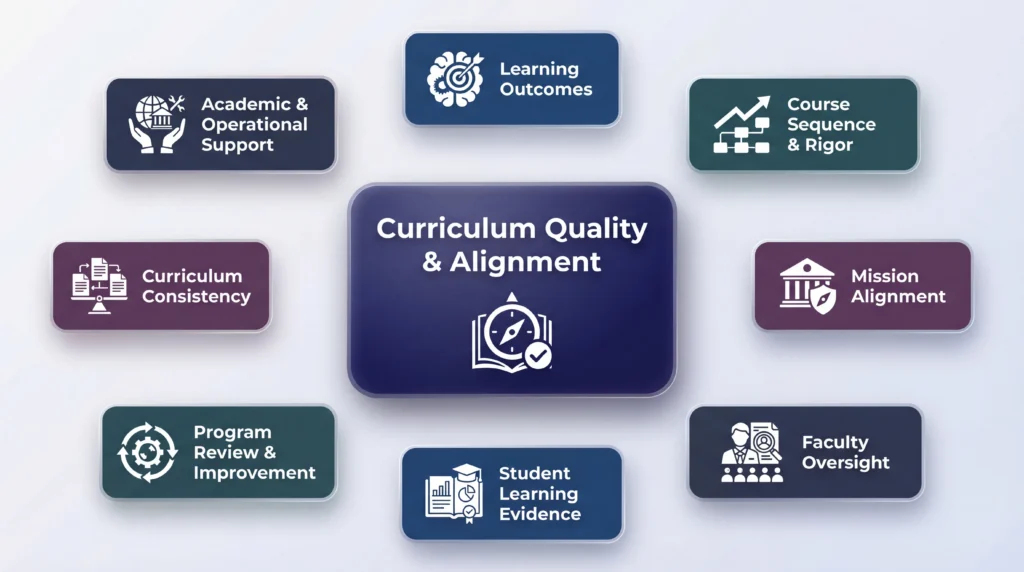
Although accreditation standards vary, the expectations around curriculum design are highly consistent. Accreditors are not looking for complexity. They are looking for clarity, alignment, and evidence that the institution can consistently deliver academic quality.
Across institutional and programmatic reviews, accreditors typically expect:
- clearly defined program and course learning outcomes
- appropriate sequence, depth, and level of rigor
- alignment between mission, curriculum, and student population
- qualified faculty oversight
- measurable evidence of student learning
- periodic program review and documented improvement
- consistency between approved curriculum and public disclosures
- sufficient academic and operational support for delivery
These expectations are not theoretical. They are directly tied to how accreditation decisions are made within the broader higher education accreditation process .
Accreditation Curriculum Standards Explained
An accreditation-ready curriculum is not just a structured program. It is a controlled academic system supported by evidence.
Institutions must demonstrate that curriculum design aligns with broader institutional accreditation expectations
This includes:
- measurable learning outcomes
- curriculum alignment across courses
- documented approval processes
- faculty involvement in curriculum governance
- assessment results linked to improvement actions
- consistency across all institutional materials
If curriculum, website, and catalog messaging do not align, the issue is not presentation. It is institutional control.
What Reviewers Expect to See in Curriculum Documentation
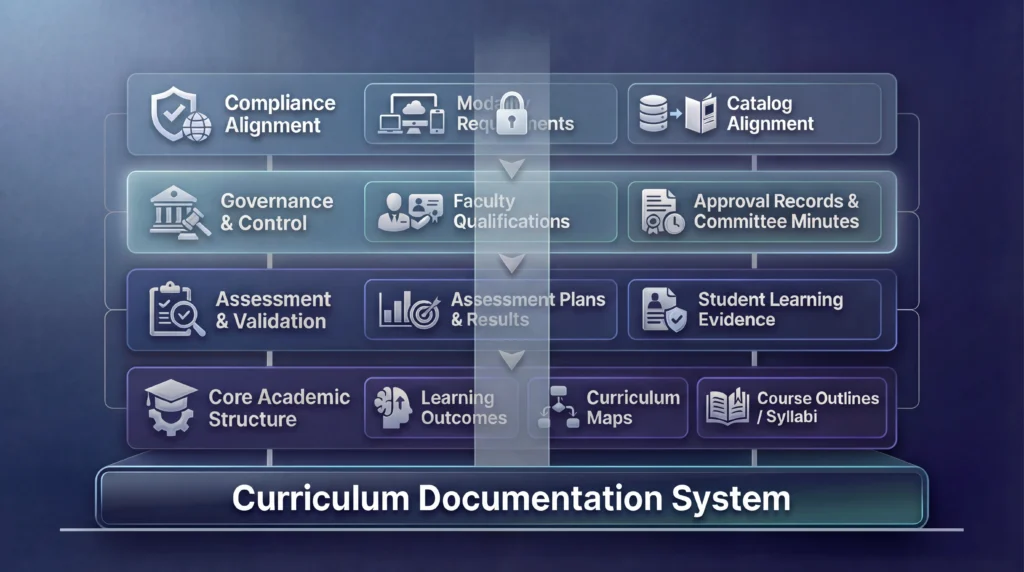
Accreditors do not rely on narrative explanations alone. They expect to see structured documentation that supports every academic claim.
A complete curriculum file typically includes:
- program and course learning outcomes
- curriculum maps
- course outlines or syllabi templates
- assessment plans and results
- faculty qualification documentation
- approval records and committee minutes
- modality-specific delivery requirements
- catalog language aligned with approved curriculum
This documentation becomes especially important during self-study preparation. If evidence cannot be retrieved quickly and consistently, reviewers assume the system is not controlled.
How Accreditors Validate Curriculum Quality
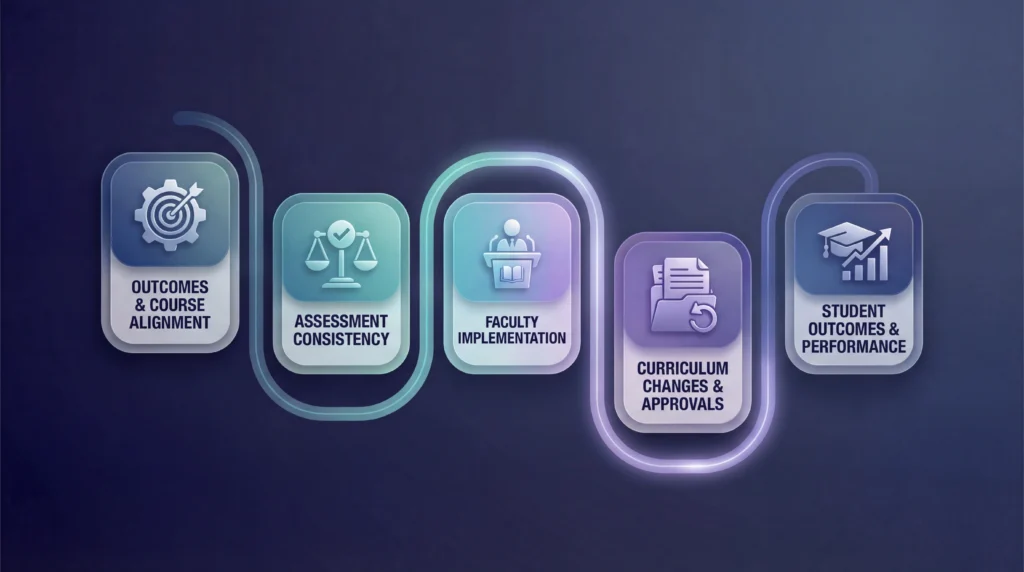
Accreditors do not evaluate curriculum quality based on design alone. They verify whether the curriculum functions in practice.
This includes:
- alignment between outcomes and course sequence
- consistency between assessment and learning objectives
- faculty understanding and implementation
- documented curriculum changes and approvals
- measurable student outcomes and performance trends
Curriculum evaluation is closely tied to broader academic measurement systems, including structured assessment strategies in higher education. When assessment and curriculum are disconnected, the institution loses credibility during review.
Institutional vs Programmatic Curriculum Expectations
Institutional accreditation evaluates the overall academic structure, while programmatic accreditation focuses on discipline-specific requirements.
Programs in fields such as nursing, business, education, and allied health must demonstrate that curriculum design meets both institutional expectations and specialized standards.
Many institutions encounter issues when they assume that institutional approval alone is sufficient. Program-level expectations often require additional rigor, alignment, and evidence.
Curriculum Requirements for Online and Hybrid Programs
Online and hybrid delivery introduce additional complexity. Accreditors expect institutions to demonstrate that curriculum design is adapted to the delivery method, not simply transferred into a digital platform.
This includes:
- structured interaction and engagement
- accessibility and usability
- assessment integrity
- student support systems
- faculty readiness for online delivery
- consistency between delivery formats
Institutions expanding online offerings must also consider regulatory requirements such as state authorization and SARA approval. Curriculum decisions in these cases directly impact compliance and operational risk.
Common Curriculum Design Mistakes in Accreditation
Most curriculum-related accreditation findings are predictable:
- learning outcomes that are not measurable
- weak alignment between courses and program goals
- inconsistent rigor across the curriculum
- lack of documented improvement based on assessment
- unclear faculty ownership and oversight
- discrepancies between curriculum and public disclosures
These issues frequently appear in broader institutional challenges, including patterns discussed in
why schools get denied accreditation. When curriculum problems are identified, they often reflect deeper system-level weaknesses.
How to Build an Accreditation-Ready Curriculum
A practical approach to curriculum design focuses on structure, alignment, and documentation:
- define institutional mission and target student population
- establish measurable program outcomes
- align courses and assessments to outcomes
- verify academic rigor and sequence
- confirm faculty qualifications and oversight
- align curriculum across all delivery formats
- ensure consistency with catalog and website
- document review cycles and improvement actions
- conduct internal audits before external review
Institutions that follow this approach reduce risk and improve readiness for accreditation reviews and long-term curriculum performance, especially when supported by structured curriculum development services.
Final Thoughts
Curriculum design is not just an academic responsibility. It is a compliance function, a quality assurance system, and a strategic asset.
Strong curriculum design reduces accreditation risk because it provides what reviewers rely on: alignment, evidence, and consistency. Weak curriculum design does the opposite. It forces institutions to explain gaps that should not exist in the first place.
Before Your Next Accreditation Review
If your curriculum cannot be clearly mapped, measured, and defended, accreditation risk is already present.
To evaluate your readiness before the next review cycle, contact us for an accreditation-readiness curriculum review.
FAQ
What makes a curriculum accreditation-ready?
An accreditation-ready curriculum is clearly structured, aligned with learning outcomes, supported by assessment evidence, and consistently documented across curriculum files, catalog, and institutional materials.
How do accreditors evaluate curriculum quality?
Accreditors evaluate curriculum by reviewing outcome alignment, course structure, assessment results, faculty oversight, and evidence of continuous improvement across the program.
Can curriculum issues lead to accreditation findings or denial?
Yes. Weak curriculum design often leads to accreditation findings when outcomes are unclear, assessment is inconsistent, or documentation does not support institutional claims.
Do online programs have different curriculum requirements for accreditation?
Yes. Online and hybrid programs must demonstrate that curriculum design supports engagement, assessment integrity, accessibility, and consistent delivery across formats.
Need help getting started? Please read the full article, share it with your academic team, and reach out to us at info@AccreditationXpert.com or call 1-833-232-1400 (that’s X-P-E-R-T). Our team is here to support your next step with clarity and confidence.