Introduction
ACCSC accreditation isn’t about sounding compliant. It’s about operating in a way that is consistent, reviewable, and defensible when an external team evaluates what your institution does and what it claims. ACCSC describes accreditation as a peer-reviewed process based on its Standards of Accreditation, which means institutions must demonstrate clear alignment between standards, operations, and documented evidence, not just intention.
Most institutions that struggle during the Self-Evaluation Report (SER) cycle don’t lack effort. They lack system control. When accreditation compliance lives in informal habits, scattered shared drives, and “the one person who knows,” it fails under scrutiny. A Quality Management System for ACCSC accreditation replaces that fragility with structure, accountability, and repeatable evidence.
This article presents a practical Quality Management System (QMS) framework for ACCSC accreditation that institutions can operate year-round. The goal is to reduce last-minute SER preparation, improve internal consistency, and maintain a clear written compliance record throughout the ACCSC evaluation cycle.
Quick Answer
A Quality Management System for ACCSC accreditation is a year-round operational system that connects ACCSC standards to accountable owners, controlled documentation, routine monitoring, and documented corrective action. It enables institutions to produce a reliable written record for the Self-Evaluation Report (SER) and site visit by making compliance processes repeatable, verifiable, and independent of staff memory or last-minute document searches.
Key Takeaways
A QMS works best when each ACCSC standard area has a clearly assigned owner with operational authority, not just advisory responsibility. Evidence control is as important as policy content because documentation that cannot be retrieved consistently is treated as missing during an ACCSC review. ACCSC revisions are communicated through Accreditation Alerts, so institutions must track updates and adjust compliance processes accordingly. Training should be managed as a controlled institutional process, particularly because ACCSC revisions have included expectations related to management and administrative training. Corrective action must include documented implementation and an effectiveness check, not just explanations or commitments.
What a QMS Means in ACCSC Accreditation

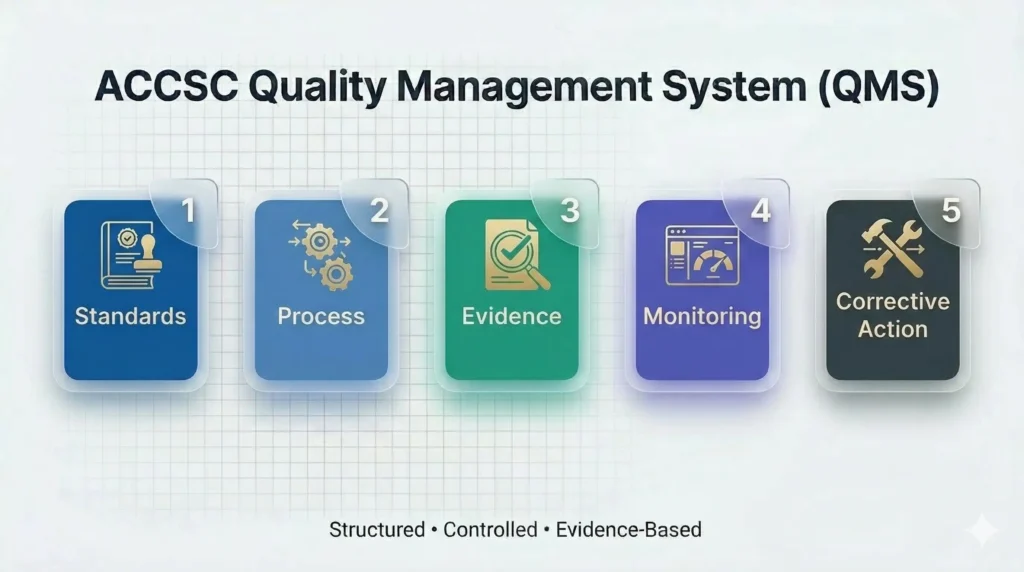
A Quality Management System for ACCSC accreditation is the institutional system that answers a reviewer’s most basic question: “How do you know this is true, and can you prove it?” In ACCSC accreditation reviews, institutions submit documentation and are evaluated through a structured process that includes on-site verification and reporting, followed by institutional responses and Commission review. If an institution cannot demonstrate a clear line from standard to process to evidence to monitoring, the burden shifts from proving compliance to explaining confusion.
A QMS also helps institutions manage operational change. Staff turnover, new programs, additional locations, new advertising, new systems, and delivery changes can all create compliance drift unless monitoring routines and evidence discipline are in place. ACCSC makes clear that standards can be revised and that revisions are announced through Accreditation Alerts, which serves as a practical reminder that “set it and forget it” is not a sustainable compliance strategy.
Finally, a QMS is not the same as a Self-Evaluation Report (SER). The SER is a major reporting output, while a QMS is the internal system that continuously produces stable evidence, allowing the SER to become an organized assembly and explanation rather than a reconstruction under pressure. ACCSC preparation guidance also emphasizes that institutional staff should be familiar with both the Application for Accreditation and the SER, since they form the basis of the on-site evaluation team’s review.
Key Terms and Definitions
Quality Management System (QMS): A clearly defined set of processes and responsibilities that allow an organization to operate consistently and improve performance over time.
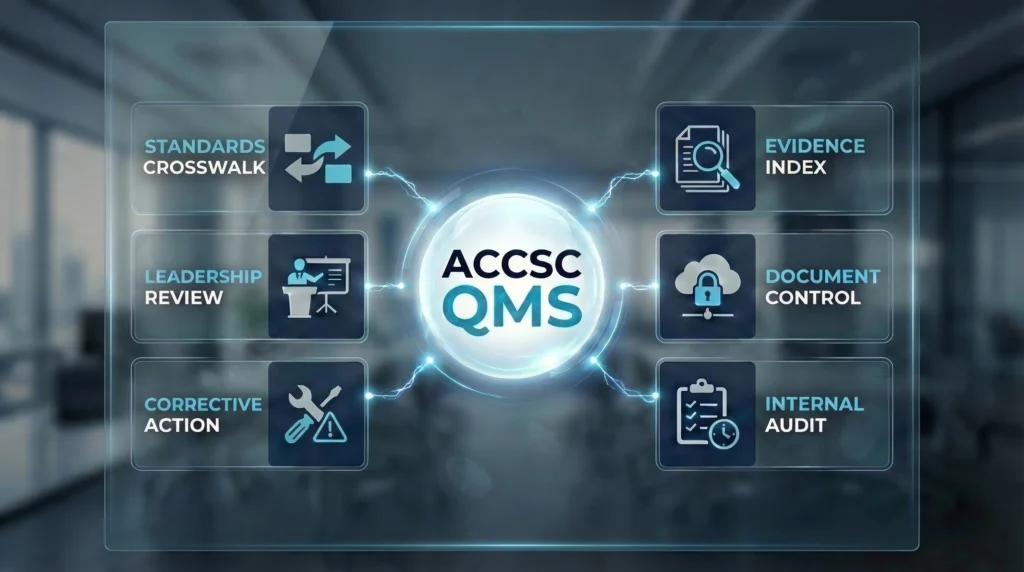
Standards Crosswalk: A working map that links each relevant ACCSC standard area to the institutional owner, the supporting process, the evidence demonstrating compliance, and the monitoring cadence that keeps evidence current.
Evidence Index: A controlled inventory of key exhibits and records used to demonstrate accreditation compliance, including where each item is stored, which version is current, and what requirement it supports.
Document and Evidence Control: The rules an institution uses to manage versions, approvals, storage, access, and retrieval of policies, publications, reports, and exhibits.
Internal Audit: A structured internal review that verifies a process is operating as defined and producing evidence that can be reviewed and confirmed.
Corrective Action: A system-level action designed to remove the cause of a compliance gap, supported by proof of implementation and an effectiveness check.
Leadership Review: A documented periodic review by leadership of results, risks, monitoring outcomes, and corrective actions, demonstrating governance oversight.
The AEC Practical QMS Framework for ACCSC

A QMS becomes credible when it is operational, not decorative. The minimum viable ACCSC Quality Management System is the smallest system that prevents predictable failures: it assigns ownership, controls evidence, schedules monitoring, documents corrective action, and shows leadership oversight. This aligns with ACCSC’s documentation-driven accreditation process, including structured submissions, on-site evaluation verification, and formal reporting.
The core of the framework is a standards crosswalk and an evidence index that the institution maintains throughout the year. ACCSC maintains a Forms and Reports structure describing applications, reports, forms, and exhibits that institutions must submit as part of the accreditation process, which is a practical reminder that your evidence system should support repeatable submissions and retrievable records.
A stronger, more mature QMS adds change-control routines and role-based training controls. ACCSC’s Accreditation Alert dated July 1, 2025, includes revisions and references to management and administrative training, which is a reminder that training is not just “nice to have.” In a QMS, training is a controlled input to institutional consistency, and consistency is what reduces accreditation findings.
Step-by-Step: How to Build or Rebuild Your ACCSC QMS
Building a Quality Management System for ACCSC accreditation typically involves the following steps.
Step 1: Start by anchoring to current ACCSC requirements and communications. ACCSC states the Standards of Accreditation are effective as of July 1, 2025 and that revisions are announced through Accreditation Alerts, which means institutions must confirm they are working from current standards and tracking updates over time.
Step 2: Build a standards crosswalk before reorganizing documentation. The crosswalk should identify the owner of each ACCSC standard area, the supporting process, the evidence set, and the monitoring cadence used to keep evidence current. This prevents departments from maintaining different interpretations of the same requirement.
Step 3: Assign accountable owners with authority. If the designated owner cannot require records, enforce deadlines, or trigger corrective action, the QMS becomes a spreadsheet that looks organized but cannot control compliance.

Step 4: Create an evidence index aligned to ACCSC reporting requirements. Because ACCSC relies heavily on institutional submissions and exhibits, the index should clarify what each artifact proves, where it is stored, and which version is current. Consistent retrieval reduces stress during the Self-Evaluation Report (SER) process and improves site visit readiness.
Step 5: Implement evidence control rules that staff can realistically follow. Version control, naming conventions, approval pathways, and storage locations should be simple enough to maintain during normal operations and staff turnover.
Step 6: Establish a monitoring cadence that survives busy periods. Monitoring should be scheduled and documented so institutions can detect compliance drift early and correct it with evidence.
Step 7: Operationalize corrective action and effectiveness checks. When gaps appear, define the issue, address the root cause, document implementation, and perform a follow-up check to confirm the solution holds over time.
Evidence Control and the Written Record
In accreditation practice, evidence that can’t be retrieved doesn’t exist. ACCSC’s process is documentation-driven, and its Forms materials make it clear that institutions must submit applications, reports, forms, and exhibits as part of the accreditation process. If your institution can’t demonstrate version control and a consistent documentation record, reviewers will perceive that as a lack of institutional control.

Evidence control starts with identifying “documents that matter,” then controlling them. Typically, this includes governance records, catalogs, and required disclosures, faculty credential files, curriculum artifacts, student file samples, complaint logs, outcomes reporting, and internal monitoring records. You do not need to over-engineer it. You do need to make it consistent, retrievable, and stable.
Monitoring, Internal Audits, and Corrective Action
Monitoring is how institutions stay ready between accreditation review cycles. Internal audits are how you test whether the institution’s documented processes are actually operating and producing the evidence they claim exists. When monitoring and audits are documented, institutions create a written record of compliance and institutional control that becomes valuable during accreditation reviews.
Corrective action is where institutions either mature or repeat the same problems later. A strong corrective action record states the gap in plain terms, identifies the scope, documents the cause, lists what changed, attaches proof of implementation, and defines an effectiveness-check window. Without an effectiveness check, institutions cannot credibly demonstrate that the fix held, which is how repeat findings occur during future accreditation reviews.
If you’re working on corrective action and root cause analysis, this practical guide breaks down the full investigation process step by step:
Common QMS Mistakes in ACCSC Accreditation
One common mistake is building a Quality Management System (QMS) that looks impressive but cannot operate under normal institutional workload. If the system depends on heroic effort, it will stop functioning the moment the institution gets busy—and institutions are always busy.
Another common mistake is vague ownership. When responsibilities live with “the committee” or “the team,” accountability becomes optional and evidence becomes inconsistent. A QMS requires clearly assigned owners with the authority to act.
A third mistake is treating evidence as something you “collect later.” ACCSC accreditation is built around documentation and verification. Institutions that perform best are those that generate evidence as a byproduct of normal operations.
A final mistake is confusing correction with corrective action. Updating a document corrects a single instance. A QMS fixes the underlying system that allowed the gap to exist and demonstrates improvement through monitoring and follow-up.
What ACCSC Reviewers Look For in Accreditation Reviews

ACCSC reviewers ultimately ask a simple question: can the institution consistently meet accreditation standards and demonstrate it through a reliable written record? ACCSC describes accreditation as a peer-reviewed evaluation based on its standards, with a process that includes documentation submission, on-site verification, reporting, and institutional response.
In practice, reviewers look for clear alignment. They expect to see the accreditation standard, the operational process, the supporting evidence, and the monitoring routine presented in a coherent and consistent way. Strong institutions also demonstrate maturity in how they handle gaps—problems are identified, corrected, and monitored for recurrence rather than explained away.
Reviewers also expect awareness of updates. ACCSC indicates that revisions are communicated through Accreditation Alerts, and institutions that actively track and adapt to these updates demonstrate stronger institutional control.
International Considerations for ACCSC Accreditation
ACCSC’s scope commonly includes institutions operating in the United States and internationally, including those delivering distance education. If an institution operates across borders or serves international learners, its Quality Management System (QMS) should define scope clearly and maintain documented controls that ensure consistency across locations, partners, and delivery modes.
International operations can introduce legal and consumer protection requirements that vary by jurisdiction. This article does not provide legal advice, and jurisdiction-specific legal obligations should be confirmed with qualified legal counsel.. In practice, a QMS should focus on what institutions can control everywhere: documented processes, evidence discipline, monitoring cadence, corrective action, and leadership oversight.
FAQ
What is a Quality Management System (QMS) in ACCSC accreditation?
A Quality Management System (QMS) in ACCSC accreditation is the institutional framework used to manage compliance with ACCSC standards through documented processes, controlled evidence, and routine monitoring. A well-implemented QMS ensures institutions can demonstrate consistent operations, maintain accreditation readiness, and produce reliable documentation during the Self-Evaluation Report (SER) and site visit process.
Do institutions need ISO 9001 certification for ACCSC accreditation?
No. ACCSC accreditation does not require ISO 9001 certification. Institutions must meet ACCSC standards and documentation requirements rather than ISO certification rules. However, many institutions adopt ISO-style quality management practices because they help structure institutional processes, ownership, documentation control, and continuous improvement.
What should institutions build first: policies or the standards crosswalk?
Institutions should start with a standards crosswalk. The crosswalk maps each ACCSC standard to the responsible owner, the operational process, the evidence used to demonstrate compliance, and the monitoring cadence used to maintain consistency. Building the crosswalk first ensures policies and documentation are aligned with accreditation requirements.
How does a QMS help institutions prepare for the Self-Evaluation Report (SER)?
A QMS reduces SER stress by turning evidence preparation into an ongoing operational process rather than a last-minute reconstruction exercise. When documentation, monitoring records, and compliance evidence are maintained year-round, institutions can assemble the SER efficiently and demonstrate readiness during the accreditation review process.
How often should institutions run monitoring and internal audits for accreditation compliance?
Monitoring and internal audits should occur frequently enough to detect compliance gaps before they become accreditation findings. High-risk or fast-changing areas may require more frequent checks, while broader institutional controls may operate on quarterly or annual cycles. The most important factor is maintaining a documented monitoring cadence.
What is the difference between a correction and a corrective action in accreditation compliance?
A correction fixes a specific issue, such as updating a document or repairing a record. A corrective action addresses the root cause of the problem so it does not recur. Effective corrective action includes implementation evidence and an effectiveness check to confirm the solution remains stable over time.
Where should a Quality Management System (QMS) be managed within an institution?
A QMS should be led by a dedicated accreditation or compliance function with authority to coordinate academic, administrative, and operational owners. Leadership support is essential because accreditation compliance requires institutional oversight, documented monitoring, and coordinated evidence management across departments.
Next Steps
If you want ACCSC accreditation readiness to be predictable, build the system that makes compliance predictable. Start by confirming current ACCSC standards and updates, create a standards crosswalk, assign accountable owners, build an evidence index, and run monitoring on a documented cadence. ACCSC’s documentation-driven process rewards institutions that can demonstrate a consistent written record supported by reliable operational controls.
If your institution is preparing for ACCSC accreditation or reaccreditation, you can schedule a free consultation with Accreditation Expert Consulting to discuss your compliance systems, documentation structure, and accreditation readiness strategy.
About the Author
Dr. Ramin Golbaghi is the Founder and CEO of Accreditation Expert Consulting (AEC), a consulting firm that supports institutions with accreditation readiness, compliance systems, evidence organization, corrective action planning, and site-visit preparation. AEC works with higher education and career education institutions to build practical systems that support sustainable accreditation compliance.

This article is provided for general informational purposes and does not constitute legal advice. ACCSC accreditation standards, procedures, forms, and interpretive guidance may change, including through Accreditation Alerts. Institutions should always confirm current requirements using official ACCSC publications before making accreditation or compliance decisions.