


Board governance in U.S. higher education is not ceremonial. A governing board is expected to protect institutional mission, independence, academic integrity, financial sustainability, and public trust. Across U.S. institutional accreditors, the language varies, but the expectations are consistent: the board must be independent enough to act in the institution’s best interests, clear about its authority, focused on policy and fiduciary oversight, and disciplined enough to stay out of day-to-day management.
Accreditation Expert Consulting Consulting helps colleges and universities build, repair, and document board governance that meets accreditor expectations, clarifies board and administration roles, and reduces institutional risk before candidacy, reaffirmation, substantive change, leadership transition, ownership transition, or corrective action.

Use a focused review to identify the governance gaps, documentation weaknesses, and role-confusion issues most likely to create accreditation exposure or board dysfunction.
Contact Accreditation Expert Consulting to discuss your board governance needs:
• Bylaws, committee structure, and governance document cleanup
• Board, president, CEO, and administration role clarity
• Accreditation-ready governance evidence, board preparation, and AI oversight support
We work with U.S. colleges and universities that need governance built correctly, repaired quickly, or documented more clearly for accreditation and institutional oversight.


Most institutions do not struggle because they lack a board. They struggle because the board’s role is unclear, outdated, passive, or poorly documented. Many colleges and universities have bylaws, committees, and meetings on paper, but they cannot clearly show how the governing board oversees mission, academic quality, financial sustainability, executive accountability, planning, compliance, and risk.
That is where governance becomes an accreditation problem. When the board cannot demonstrate independence, written authority, policy-level oversight, conflict-of-interest controls, and regular self-evaluation, accreditors start asking harder questions about institutional integrity, autonomy, planning, and public accountability. In a market shaped by financial pressure, online expansion, AI adoption, and leadership turnover, weak governance becomes expensive fast.
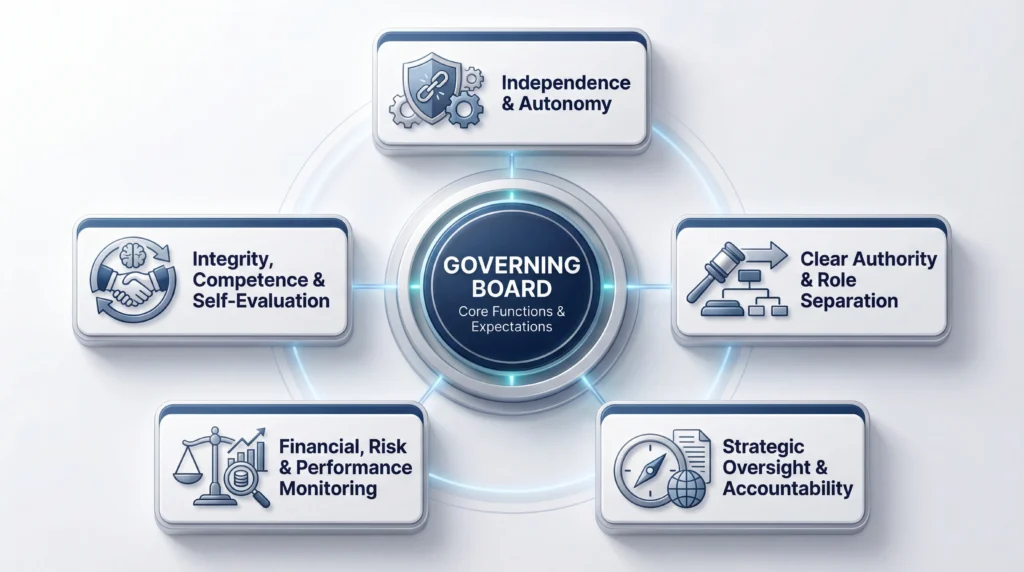
Across major institutional accreditors, the core governance expectations are consistent. A governing board is expected to be independent enough to act in the institution’s best interests, clear about its authority, disciplined in its oversight role, and strong enough to protect mission, integrity, academic quality, and fiscal stability.
Board autonomy and institutional independence
The governing board must be able to act in the best interests of the institution and its students, free from improper outside influence. That includes protection from undue control by owners, donors, politics, founders, or related entities.
Clear written authority and separation from management
The institution must clearly define the authority and relationship among the board, administration, faculty, and any sponsoring or related entities. Trustees are expected to govern at the policy and fiduciary level. They are not supposed to run daily operations.
Oversight of mission, quality, finance, risk, and executive accountability
The board is expected to oversee institutional mission, financial sustainability, strategic direction, executive performance, and broad institutional effectiveness. That includes asking hard questions, reviewing meaningful data, and ensuring the institution has the capacity to meet its obligations.
Integrity, conflict controls, board competence, and self-evaluation
Strong governance requires more than meetings and minutes. Accreditors expect boards to operate with integrity, use conflict-of-interest controls, include qualified members, and assess their own effectiveness over time.
We can start with a focused Board Governance Diagnostic and turn it into a prioritized action roadmap your institution can use immediately.
This is not generic nonprofit board advice. Accreditation Expert Consulting provides accreditation-focused board governance consulting for colleges and universities in the United States.
• Governance narrative support for self-study and accreditation reports
• Evidence mapping for governance-related standards
• Board interview preparation for site visits and review teams
• Support during monitoring, warning, corrective action, or substantive change
• Governance alignment with broader accreditation review improvement efforts

Some institutions need a focused review. Others need a deeper redesign. We support both with a practical, document-driven process.
AI is now a board governance issue in U.S. higher education. It affects academic integrity, privacy, accessibility, cybersecurity, vendor risk, bias, decision accountability, and institutional reputation. If the board is not asking how AI is being used, approved, monitored, and governed, the institution is already behind.
Boards do not need to become technical experts. They do need to govern responsibly. That means AI should be treated as an institutional oversight issue, not a side project inside IT, marketing, or academic affairs.

Institutions do not call us because they want theory. They call because governance is unclear, documentation is weak, the board is overreaching or underperforming, and the next accreditation or leadership transition will expose the problem if nothing changes.
Board governance does not stand alone. It connects directly to Strategic Planning in Higher Education, Risk Management, and Self Evaluation (Self-Study), along with the institution’s broader accreditation strategy.
Board governance in higher education is the system by which a governing board holds fiduciary and policy responsibility for institutional mission, integrity, executive accountability, and financial oversight while administration manages day-to-day operations.
Accreditors generally expect board independence, clear written authority, policy-level oversight, strong financial oversight, conflict-of-interest controls, executive accountability, and regular board self-evaluation.
No. Trustees are expected to govern, not manage. The board should set direction, approve policy, monitor performance, and hold leadership accountable. Administration is responsible for day-to-day operations.
Yes. We help institutions review or develop bylaws, board charters, committee charters, governance policies, board orientation, and trustee development processes.
Yes. We help institutions map governance-related evidence, strengthen narratives, prepare board-facing materials, and support governance sections tied to candidacy, reaffirmation, substantive change, monitoring, or corrective action.
AI creates new board-level responsibilities around privacy, accessibility, academic integrity, vendor oversight, cybersecurity, bias, human review, and institutional risk. Boards need policy, oversight, and reporting structures that address these areas directly.
Some institutions need governance built correctly from day one. Others already have a board, but the structure is weak, the roles are confused, the documents are outdated, or the oversight is not credible. We help both.
Contact Accreditation Expert Consulting to discuss your board governance needs.
If your institution is preparing for candidacy, reaffirmation, substantive change, leadership transition, online expansion, or corrective action, governance is not the section to fake. It needs to be clear, operational, and provable.
Ready to move forward? Contact Accreditation Expert Consulting to establish, strengthen, or repair board governance for your college or university.
Accreditation Expert Consulting helps colleges, universities, and training providers successfully navigate the BPPE approval process. From state readiness assessments to full compliance documentation, our team ensures your application meets California’s educational standards—efficiently and accurately.
Our goal is to help you achieve successful approval from your state and ensure the process is as efficient and stress-free as possible for you and your team.
“Accreditation Expert Consulting Team”
Our goal is to help you find exactly what you need and explore your options.
