
Introduction
Most institutions do not struggle with DEAC accreditation because they lack effort. They struggle because their compliance systems often live in scattered folders, inconsistent documentation habits, and a few staff members who “just know how things work.” That approach may hold together for a while, but it usually breaks down when the institution faces Self-Evaluation Report (SER) preparation, evaluator questions, operational changes, or staff turnover. At that point, the institution is not short on good intentions. It is short on verifiable evidence, consistent processes, and compliance control.
A well-designed DEAC Quality Management System (QMS) solves this problem. Instead of relying on memory, individual expertise, or last-minute document gathering, a QMS provides a structured compliance framework built on ownership, repeatable processes, controlled documentation, routine monitoring, corrective action, and leadership oversight. In practice, this is how institutions maintain continuous readiness for accreditation reviews and reduce operational risk across academic and administrative functions.
If your institution is building or strengthening its overall accreditation compliance structure, it may also help to understand how a broader higher education accreditation compliance framework supports institutional governance, documentation discipline, and long-term regulatory readiness.
When implemented correctly, a Quality Management System for DEAC accreditation transforms compliance from a reactive project into a normal operational condition. Instead of preparing for accreditation only during review cycles, institutions maintain a stable written record that continuously demonstrates alignment with DEAC standards and institutional responsibilities.
This article provides a practical framework institutions can implement and sustain. It focuses on what matters most during DEAC evaluation: the ability to demonstrate compliance through a defensible written record supported by consistent institutional processes and documented improvement.
Quick Answer
A DEAC Quality Management System (QMS) is a structured set of documented processes, ownership assignments, and evidence management routines that help an institution consistently meet DEAC accreditation standards and demonstrate compliance through the written record.
A well-implemented QMS links each accreditation requirement to:
- a responsible institutional owner
- controlled evidence and documentation
- a defined monitoring cadence
- corrective action procedures when gaps appear
In practical terms, a DEAC Quality Management System (QMS) is the institutional structure that ensures accreditation compliance can be demonstrated through a stable, verifiable written record rather than informal knowledge or last-minute document collection.
The goal of a QMS is not to create additional paperwork. The goal is to establish reliable, repeatable compliance processes that institutions can demonstrate during accreditation review.
For reference, institutions can review official expectations and guidance published by the Distance Education Accrediting Commission (DEAC).
Key Takeaways
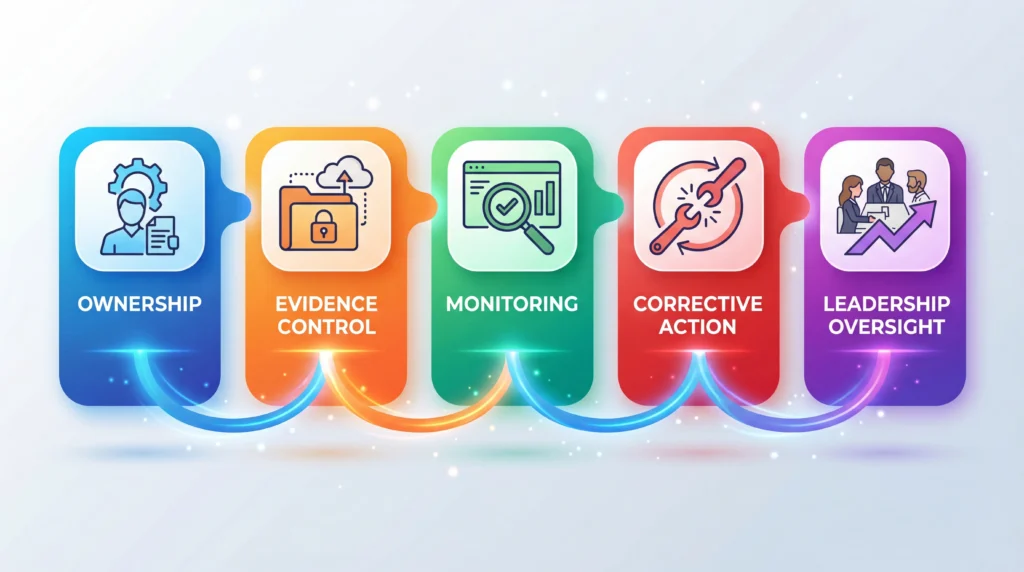
A DEAC Quality Management System (QMS) works effectively when accreditation responsibilities are owned by specific individuals with authority rather than loosely assigned committees. Clear ownership ensures monitoring occurs regularly and prevents compliance activities from depending on informal institutional memory.
Evidence control is equally critical. Even when policies and procedures exist, inconsistent or unretrievable documentation is often treated as missing evidence during accreditation review. Institutions that implement controlled documentation practices significantly reduce compliance risk.
Monitoring must operate on a predictable schedule. Compliance systems should continue functioning during busy operational periods, not only when an accreditation review approaches. Routine internal monitoring helps institutions detect gaps early and maintain alignment with DEAC standards and institutional policies.
Corrective action must address the underlying system that produced the gap. Updating a single document may resolve a symptom, but lasting compliance requires correcting the process that allowed the issue to occur.
Finally, leadership oversight must be documented. Accreditation reviewers expect to see evidence that compliance activities are governed through institutional leadership review, formal decision-making, and documented follow-through. This demonstrates that compliance is systematically managed rather than informally improvised.
What a QMS Means in DEAC Accreditation
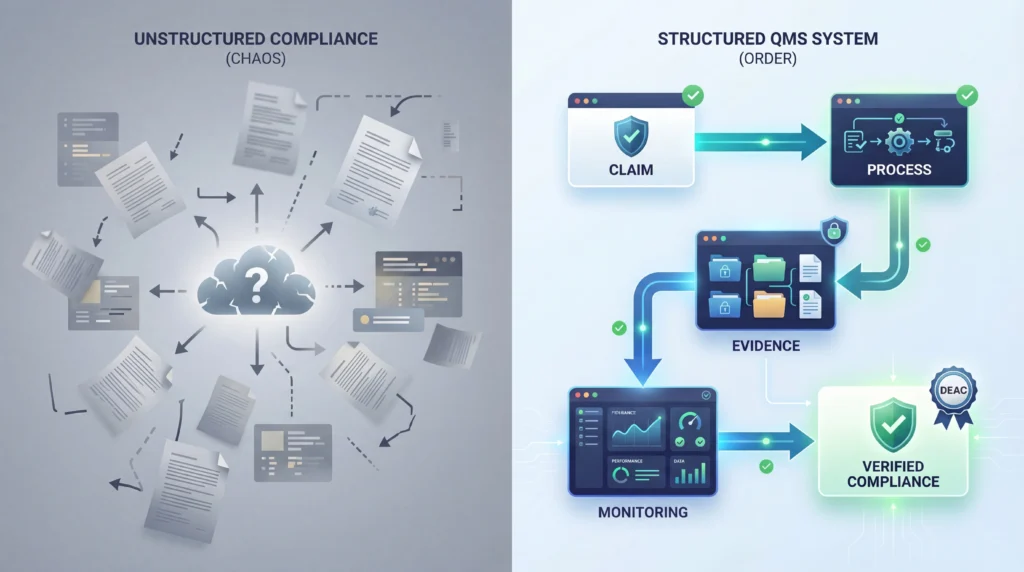
In practical terms, a DEAC Quality Management System (QMS) is the institutional structure that allows schools to respond to evaluator questions without scrambling for documents or explanations. When an institution claims compliance with DEAC accreditation standards, the QMS makes it possible to demonstrate the process behind that claim, including the responsible owner, the supporting evidence, the documented procedure, and the monitoring routine that keeps the requirement valid over time. Without that structure, institutions often rely on narratives that sound confident but cannot be consistently verified during accreditation review.
A DEAC-focused Quality Management System should reflect how accreditation evaluators assess institutions in practice. Accreditation is not evaluated as a single moment or a single document submission. Instead, reviewers look for a consistent written record of operations, outcomes, oversight, and institutional capacity. This means documentation discipline, version control, internal monitoring, and follow-through must operate continuously, not only during Self-Evaluation Report (SER) preparation.
Institutions that want to strengthen their overall compliance systems often build these processes within a broader accreditation review and improvement framework that connects institutional governance, documentation practices, and ongoing monitoring of accreditation responsibilities.
A Quality Management System for DEAC accreditation also becomes especially important during periods of institutional change. Many DEAC-accredited institutions evolve quickly, particularly those delivering distance education or expanding online learning programs. When programs, platforms, staffing structures, student populations, or delivery models change, compliance drift can occur. A properly designed QMS functions as a control structure that detects these shifts early and documents how the institution identified the issue, implemented corrective action, and restored alignment with DEAC standards.
Related Article: Accreditation Compliance Gap: Hidden Risks Institutions Must Address Before It’s Too Late
Key Terms and Definitions
Quality Management System (QMS): The set of institutional processes, responsibilities, controls, monitoring routines, and improvement practices used to deliver consistent outcomes and demonstrate accreditation compliance over time.
DEAC Standards Map (Crosswalk): A working map that links DEAC accreditation requirements to the institutional owner responsible for each standard, the supporting process, the evidence that demonstrates compliance, and the monitoring cadence that keeps documentation current.
Evidence Index: A controlled list of key documents, records, data points, and exhibits that demonstrate accreditation compliance, including where each item is stored and which version is considered the official record.
Monitoring Cadence: A documented schedule of recurring internal checks that verify institutional processes are operating as intended and producing compliance evidence consistently.
Corrective Action: A system-level fix designed to remove the root cause of a compliance gap and reduce the likelihood of recurrence, supported by verification evidence and a follow-up effectiveness review.
Effectiveness Check: A documented follow-up review confirming that a corrective action resolved the issue over time rather than only appearing successful when it was first implemented.
The AEC Practical QMS Framework for DEAC
A DEAC Quality Management System (QMS) becomes valuable only when it is operational. That means it influences how an institution runs daily activities, how compliance evidence is stored, and how gaps are identified and corrected. Effective DEAC-aligned QMS models typically rely on a small set of structural building blocks that are practical enough to sustain and strong enough to defend during accreditation review.
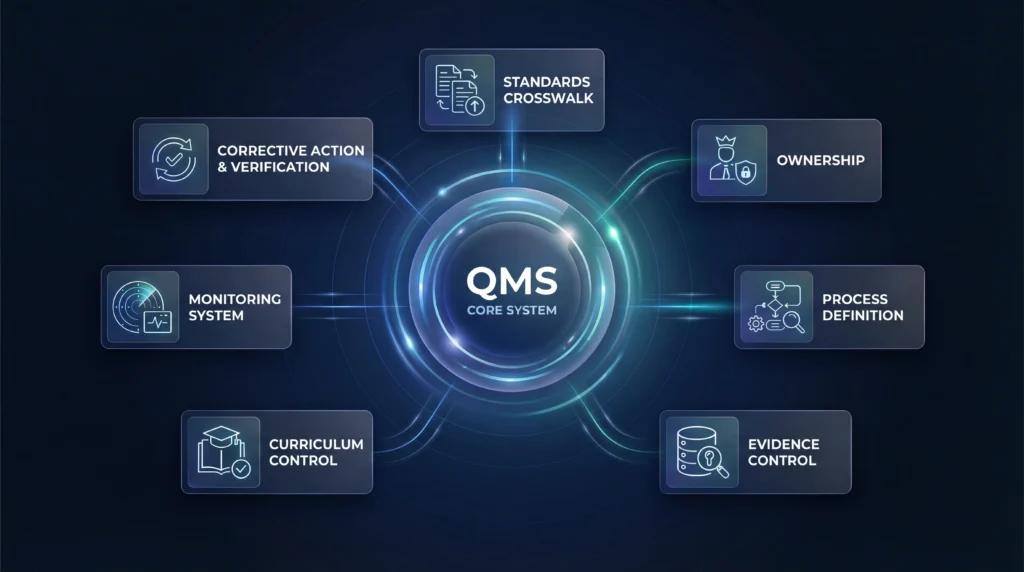
The first building block is standards alignment through a living crosswalk. Institutions lose control when accreditation standards are treated as something to interpret only during Self-Evaluation Report (SER) preparation. A well-structured QMS manages standards year-round through a crosswalk that connects each requirement to an institutional owner, supporting evidence, and a defined monitoring routine.
The second building block is clear ownership. Every standard area requires an accountable owner who has the authority to request documentation, enforce timelines, and trigger corrective action when gaps appear. When ownership is vague, monitoring becomes inconsistent and compliance evidence quickly becomes unreliable.
The third building block is process definition. If a critical compliance process exists only as “how we usually do it,” it will inevitably change when staffing changes. A DEAC-aligned QMS defines core processes clearly enough that different staff members can execute them consistently and produce reliable documentation.
The fourth building block is evidence control. Evidence must be consistent, current, and retrievable. This requires version control, naming conventions, approval workflows, retention rules, and a clearly defined location of record. Institutions that maintain strong evidence discipline significantly increase reviewer confidence because their compliance claims are supported by verifiable documentation.
The fifth building block is curriculum and learning materials control. DEAC institutions must demonstrate that educational offerings are structured, current, aligned to outcomes, and delivered consistently. If curriculum updates occur informally or documentation of those changes is incomplete, institutions create avoidable accreditation risks.
accreditation cycles. These reviews should occur on a routine schedule and produce documented records showing what was reviewed, what issues were identified, and how those issues were resolved. Institutions that implement structured monitoring often integrate these reviews into broader accreditation non-compliance investigation processes to ensure problems are addressed systematically.
The seventh building block is corrective action with verification and follow-up. A QMS does not end when a problem is identified. Institutions must document how the root cause was addressed, how implementation was verified, and how effectiveness was confirmed over time.
The seventh building block is corrective action with verification and follow-up. A QMS does not end when a problem is identified. Institutions must document how the root cause was addressed, how implementation was verified, and how effectiveness was confirmed over time.
Step-by-Step: How to Build or Rebuild Your DEAC QMS
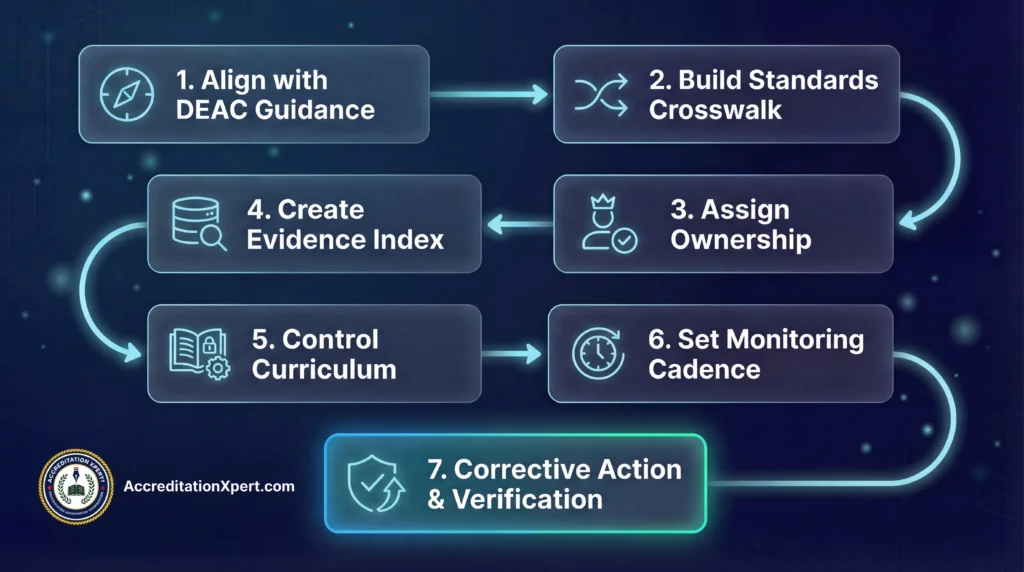
Step 1: Anchor your system to current DEAC guidance
Begin by aligning your DEAC Quality Management System (QMS) with the most current guidance published by the Distance Education Accrediting Commission (DEAC). Your QMS crosswalk, evidence index, and monitoring plan should be built using the latest DEAC Handbook, reporting templates, and submission instructions. Building your system on outdated guidance often creates misalignment that later appears as inconsistencies or missing compliance elements during accreditation review.
Step 2: Build the DEAC standards crosswalk
Create a structured crosswalk that connects each accreditation requirement to a responsible owner, the operational process supporting that requirement, the evidence demonstrating compliance, and the monitoring cadence used to keep documentation current. A strong crosswalk should be clear enough that a new staff member can understand who owns each requirement and where supporting evidence is located without needing extensive institutional guidance.
Step 3: Assign owners with real authority
Each standard area must have a clearly designated owner who can request records, enforce compliance activities, and trigger corrective action when gaps appear. If ownership exists only on paper and lacks authority, the compliance system becomes theoretical rather than operational.
Step 4: Create the evidence index
The evidence index functions as a verification tool rather than a simple filing system. It should identify each key artifact, where it is stored, which version is current, and what requirement it supports. Institutions that maintain an evidence index throughout the year significantly reduce Self-Evaluation Report (SER) preparation because they are assembling documentation rather than searching for it.
Step 5: Establish curriculum and instructional control
Curriculum updates should follow a documented process that includes review, approval, implementation, communication, and version control. Instructional materials must be managed in a way that allows institutions to demonstrate what was delivered, when it was delivered, and how those materials align with stated learning outcomes.
Step 6: Set a realistic monitoring cadence
Monitoring schedules must be sustainable. Monthly reviews of high-change areas, quarterly checks of core operational processes, and annual leadership reviews are common structures, but the appropriate cadence depends on institutional size, complexity, and risk exposure. The key requirement is that monitoring occurs regularly, is documented, and leads to corrective action when gaps appear.
Step 7: Implement corrective action and effectiveness checks
Corrective action should document what went wrong, why the issue occurred, what process changes were implemented, and what evidence confirms the correction. Institutions must also perform effectiveness checks to confirm that the solution continues to work over time rather than only appearing successful at the moment it was implemented.
Evidence Control and Written-Record Discipline
If compliance evidence cannot be retrieved reliably, it effectively does not exist for accreditation purposes. This is not a philosophical point—it is a practical one. Accreditation reviewers can only evaluate what they can verify, and verification depends on documentation being stable, current, and consistently maintained within the institution’s accreditation compliance system.
If compliance evidence cannot be retrieved reliably, it effectively does not exist for accreditation purposes. This is not a philosophical point—it is a practical one. Accreditation reviewers can only evaluate what they can verify, and verification depends on documentation being stable, current, and consistently maintained within the institution’s accreditation compliance system.
Written-record discipline also means the institution can reproduce what was accurate at the time of submission. When institutions reference websites, frequently updated documents, or evolving dashboards, they should maintain a preserved record of what reviewers were able to see during the evaluation period. This approach is not about excessive caution. It is about eliminating preventable disputes over what evidence was presented and when it was presented during accreditation review.
Monitoring, Reporting, and Staying Ready Between Cycles
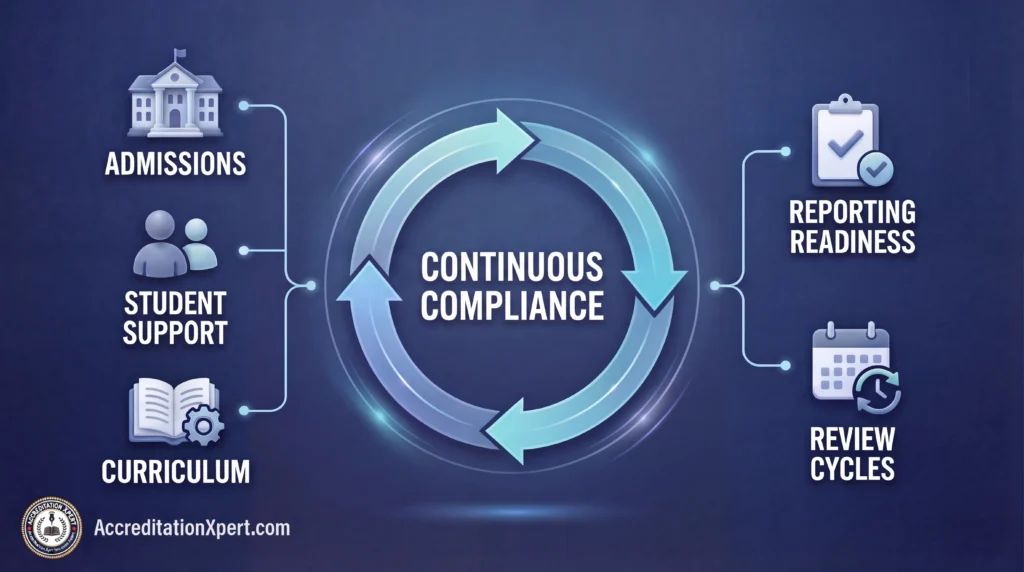
A DEAC-aligned Quality Management System (QMS) delivers the most value between accreditation cycles, because that is when compliance drift is most likely to occur. Changes in staffing, new academic programs, technology platform migrations, marketing adjustments, institutional growth, and evolving student needs can all affect accreditation compliance. Institutions that review compliance only during Self-Evaluation Report (SER) preparation often discover issues too late to address them in a controlled and systematic way.
Monitoring should focus on the areas most likely to create accreditation findings, operational confusion, or credibility gaps. For many institutions, that includes admissions integrity and communications, documentation of student support responses, complaint routing and resolution records, faculty assignment and oversight, course delivery consistency, curriculum change control, and outcomes documentation.
Reporting readiness is also part of staying prepared. Institutions should maintain a compliance calendar that tracks internal monitoring cycles, document review cycles, leadership review cycles, and any required DEAC submissions or institutional updates applicable to the institution’s scope. This keeps compliance from depending on institutional memory and makes it much harder for critical obligations to quietly slip.
Common QMS Mistakes in DEAC Accreditation
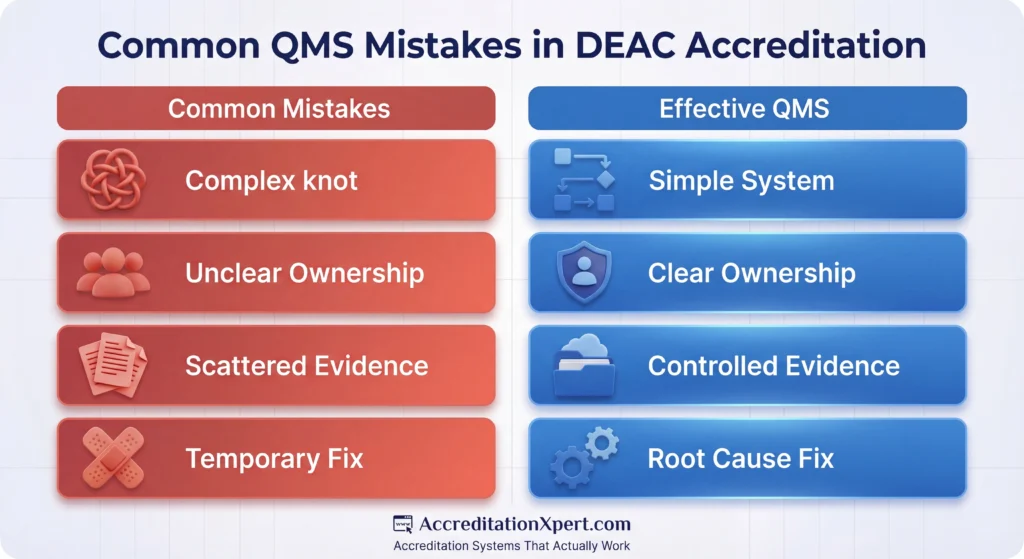
A common mistake institutions make when building a Quality Management System (QMS) is creating a structure that looks impressive but cannot be sustained operationally. Institutions sometimes design complex committees, elaborate templates, and extensive compliance checklists, only to abandon them when workloads increase. In practice, a smaller system that runs consistently will almost always outperform a perfect system that exists only on paper.
Another frequent mistake is weak ownership. When responsibility is distributed across vague groups such as “teams” or “everyone,” accountability becomes optional and compliance evidence quickly becomes inconsistent. Effective compliance systems require clearly assigned ownership so that someone is responsible for monitoring requirements, maintaining documentation, and ensuring follow-through.
A third mistake is unmanaged evidence. When multiple versions of key documents exist, or when compliance evidence cannot be retrieved quickly, accreditation reviewers lose confidence in the institution’s documentation practices. These situations often lead to findings that could have been avoided simply through consistent version control and a well-maintained evidence index.
A final mistake is confusing corrections with corrective actions. Updating a single file or fixing a webpage is a correction. If the underlying process that allowed the gap to occur remains unchanged, the same issue will eventually return. Effective corrective action addresses the root cause and ensures that the system producing the problem is improved rather than temporarily patched.
What DEAC Reviewers Look For in a Quality Management System
DEAC reviewers evaluate whether an institution not only claims compliance with accreditation standards but can demonstrate that compliance through a clear and verifiable written record. They look for alignment between institutional policies, operational practices, and the evidence presented during review. Consistency across staff, departments, and time is particularly important, because accreditation reviewers expect processes to function reliably rather than depend on individual effort.
Reviewers also evaluate institutional maturity in accreditation compliance. This is visible when monitoring activities occur routinely rather than reactively, when corrective actions are documented with supporting evidence, and when leadership oversight appears clearly in the institutional record. Institutions that maintain a stable cycle of monitoring, improvement, and follow-through are generally easier for reviewers to evaluate because their compliance systems are structured, transparent, and well documented.
International Considerations for DEAC-Aligned QMS
Some DEAC-accredited institutions operate internationally or serve students outside the United States. Cross-border activity can introduce additional complexity related to student disclosures, complaint processes, identity verification expectations, partnership arrangements, and consumer protection obligations. A Quality Management System (QMS) should treat international operations as a defined compliance scope and ensure that institutional processes and supporting evidence remain consistent and reviewable regardless of location.
Legal and regulatory requirements outside the United States vary widely and should not be assumed. Institutions should confirm jurisdiction-specific obligations with qualified legal counsel when necessary. From an accreditation perspective, the QMS should focus on what the institution can consistently control: documented processes, controlled evidence, routine monitoring, corrective action practices, and leadership oversight that demonstrate reliable accreditation compliance,particularly during formal accreditation reviews such as an accreditation review and improvement process.
FAQ
What does a Quality Management System (QMS) mean for a DEAC-accredited institution?
A Quality Management System (QMS) is the structured institutional framework that keeps an institution aligned with DEAC accreditation standards on an ongoing basis. It includes clear ownership of requirements, controlled evidence, routine monitoring, and documented improvement processes that allow the institution to demonstrate compliance through a reliable written record.
Do institutions need ISO certification for DEAC accreditation?
No. DEAC accreditation is based on compliance with DEAC standards and procedures, not ISO certification. While ISO-style quality management concepts can sometimes help institutions structure internal processes, ISO certification itself is not required for DEAC accreditation.
What is the fastest way to become SER-ready for DEAC accreditation?
The fastest way to improve Self-Evaluation Report (SER) readiness is to build a DEAC standards crosswalk and maintain a structured evidence index. These tools clarify ownership, organize documentation, and turn evidence collection into an ongoing process rather than a last-minute effort.
How should institutions manage curriculum updates within a QMS?
Curriculum updates should follow a documented process that includes review, approval, implementation, and version control. Institutions should maintain records showing what changes were made, why they were made, and how academic outcomes alignment was preserved.
What areas should institutions monitor most frequently?
Institutions should monitor high-risk and high-change areas more frequently. These often include admissions communications, complaint handling processes, student support documentation, course delivery consistency, and evidence management practices. Deeper academic and outcomes reviews are often conducted quarterly or annually depending on institutional risk.
How can institutions prevent repeated accreditation findings?
Repeated accreditation findings usually occur when institutions correct symptoms but fail to fix the underlying system. Prevention requires clear ownership, routine monitoring, evidence control, root-cause corrective action, and documented effectiveness checks that confirm the issue has been resolved.
How can institutions demonstrate continuous improvement during accreditation reviews?
Continuous improvement is demonstrated through a documented review cycle. Institutions should record what was monitored, what issues were identified, what corrective actions were implemented, and what follow-up verification confirmed the improvements remained effective over time.
Next Steps
If you want DEAC accreditation readiness to feel predictable, stable, and controlled, the key is to build the internal systems that make compliance routine rather than reactive. Start by anchoring your processes to the current DEAC Handbook and official guidance, then develop a clear standards crosswalk, assign accountable owners for each requirement, create a structured evidence index, and establish a monitoring cadence your institution can realistically sustain. When corrective actions, documentation controls, and leadership oversight are consistently recorded, accreditation compliance becomes easier to demonstrate and far easier to manage.
If your institution needs support building a DEAC-aligned Quality Management System (QMS) that works in practice—not just on paper—consider speaking with our accreditation specialists. Schedule a consultation with Accreditation Expert Consulting to discuss how we can help your institution strengthen accreditation readiness, compliance systems, and evidence organization.
About the Author

Accreditation Expert Consulting (AEC) provides fact-based guidance on accreditation readiness, compliance systems, corrective action planning, and evidence organization for higher education institutions. AEC supports institutions pursuing accreditation and maintaining ongoing compliance through practical tools, monitoring systems, and standards-aligned documentation practices.
This article is provided for general informational purposes and does not constitute legal advice. DEAC standards, procedures, templates, and expectations can change, and institutional obligations vary depending on scope, programs, delivery methods, and operational structure. Always confirm requirements using current DEAC documentation and consult qualified professionals for jurisdiction-specific legal questions.