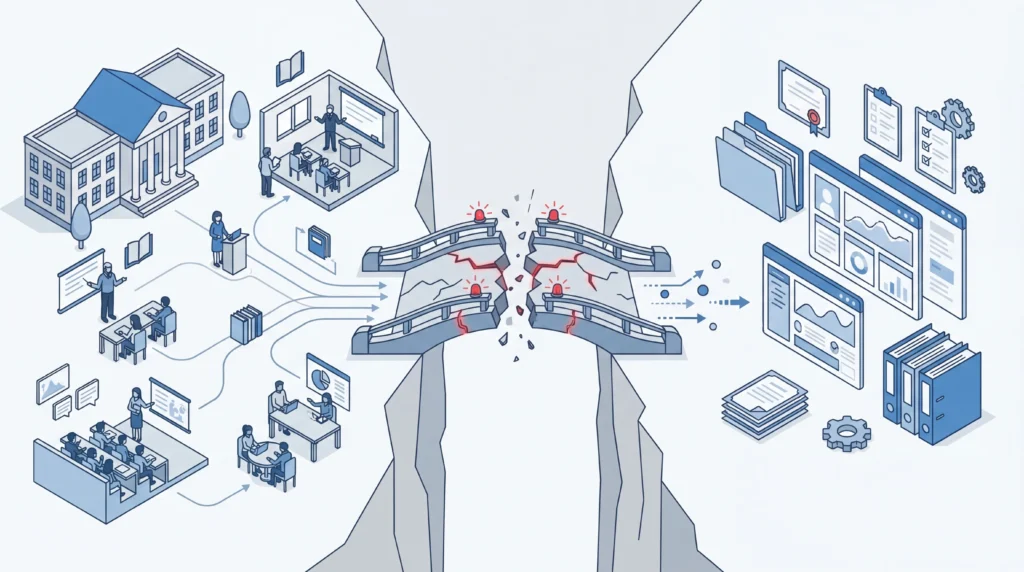
The accreditation compliance gap is the disconnect between what an institution is doing and what it can actually prove through documentation, reporting, and controlled processes.
In accreditation reviews, intent doesn’t matter. Evidence does. Institutions that assume they are compliant often fail not because of major violations, but because they cannot demonstrate consistency, ownership, and traceable records when evaluators ask for proof.
In this episode of Accreditation & Beyond, Dr. Ramin Golbaghi and Sam Askari break down how compliance gaps form, why institutions often overlook them, and what leaders must do to prevent accreditation risk before it impacts approval or institutional standing.
What Is an Accreditation Compliance Gap?
An accreditation compliance gap appears when institutional practices are not fully aligned with documented evidence, policies, or reporting expectations.
This gap often includes:
- Missing or outdated documentation
- Incomplete faculty records
- Misaligned learning outcomes
- Untracked student achievement data
- Policies that exist but are not implemented in practice
Accreditors evaluate institutions based on what can be verified, not what is assumed. If documentation does not reflect operations accurately, the institution is considered non-compliant regardless of intent.
Real-World Compliance Failures That Lead to Accreditation Risk
Based on real accreditation consulting cases, compliance gaps rarely start as major failures. They begin as small oversights that accumulate over time.
Examples include:
- A college that failed to update its faculty matrix after staffing changes
- An institution that delayed revising its refund policy and received a formal citation
- Programs operating with outdated curriculum documentation not aligned with current delivery
These issues are not operational disasters. They are documentation and control failures. But from an accreditor’s perspective, they signal risk.
Related Article : Accreditation Non-Compliance Investigation: Root Cause & Corrective Action Guide
How Enrollment Decline Increases Compliance Risk
When enrollment declines, institutional focus naturally shifts toward:
- Marketing and recruitment
- New program development
- Revenue stabilization
But this shift often comes at a cost.
Compliance systems become under-resourced. Documentation routines break down. Oversight becomes inconsistent.
In many institutions, compliance roles are treated as secondary functions. During periods of financial pressure, they are often reduced or deprioritized, increasing the likelihood of unnoticed compliance gaps.
How Accreditation Expectations Are Changing in 2026
Accreditors are no longer satisfied with static compliance.
Today, institutions are expected to demonstrate:
- Continuous monitoring
- Evidence of improvement
- Alignment with current workforce and student outcomes
- Documented adaptation to operational changes
The accreditation process has evolved into a deeper, evidence-based review of institutional effectiveness, not just policy presence, but how institutions demonstrate compliance in practice, as emphasized by organizations such as the Council for Higher Education Accreditation.
Early Warning Signs of Compliance Gaps in Institutions
Most compliance failures are predictable. Institutions that know what to look for can identify issues before they escalate.
Common warning signs include:
- Delayed updates to catalogs, handbooks, or policies
- Outdated faculty CVs or missing credentials
- Learning outcomes that do not match actual instruction
- “Template” policies not adapted to institutional reality
- Inconsistent reporting across departments
If these signals are present, the compliance gap is already forming.
How to Build a Sustainable Compliance Documentation System
Closing the compliance gap requires more than fixing documents. It requires building a system.
Effective institutions implement:
- Clear ownership for every compliance area
- Controlled documentation processes
- Scheduled internal audits
- Ongoing monitoring routines
- A centralized evidence structure
This is where a structured Quality Management System (QMS) becomes critical.
What to Do If Your Institution Has Compliance Gaps
If compliance gaps already exist, the worst response is delay or silence.
A structured response should include:
- Documenting what is missing
- Identifying root causes
- Implementing corrective actions
- Establishing tracking mechanisms
- Creating a clear timeline for resolution
Accreditors are more likely to accept institutions that demonstrate control and transparency than those that attempt to hide inconsistencies.
Final Thoughts: Why Continuous Compliance Matters for Accreditation
Compliance is not a one-time requirement. It is an ongoing operational discipline.
The real risk is not intentional non-compliance. It is inconsistent execution over time.
Institutions that succeed in accreditation are not those that prepare right before a review. They are those that operate with controlled systems, reliable documentation, and continuous oversight.
Not sure if your institution has compliance gaps?
Get a clear, structured review before your next accreditation review.
FAQ
What is an accreditation compliance gap?
An accreditation compliance gap is the difference between what an institution is doing operationally and what it can prove through documented evidence during an accreditation review. Even if processes are functioning, missing, outdated, or inconsistent documentation can lead to findings, citations, or loss of approval.
What are the most common signs of accreditation non-compliance?
Common signs include outdated policies, incomplete faculty records, inconsistent reporting, misaligned learning outcomes, and delayed updates to catalogs or student data. These issues often indicate deeper gaps in documentation control and internal oversight that accreditors closely evaluate.
How can institutions fix accreditation compliance gaps before a review?
Institutions can fix compliance gaps by identifying missing documentation, assigning clear ownership, implementing corrective actions, and establishing ongoing monitoring systems. A structured compliance review helps uncover hidden risks and ensures readiness before an accreditation visit.


