



Strategic planning in higher education is the institution-wide process U.S. colleges and universities use to align mission, priorities, budgets, evidence, and decision-making with long-term sustainability and accreditation expectations.
We help colleges and universities across the United States build, refresh, and implement strategic plans that are measurable, budget-linked, accreditation-ready, and usable by presidents, provosts, boards, and campus leadership teams.

Request a Strategic Planning Review to identify the biggest gaps in your current planning process before they become budget, governance, or accreditation problems.
We work with U.S. colleges and universities that need strategic planning built correctly, refreshed intelligently, or reconnected to real institutional decisions.
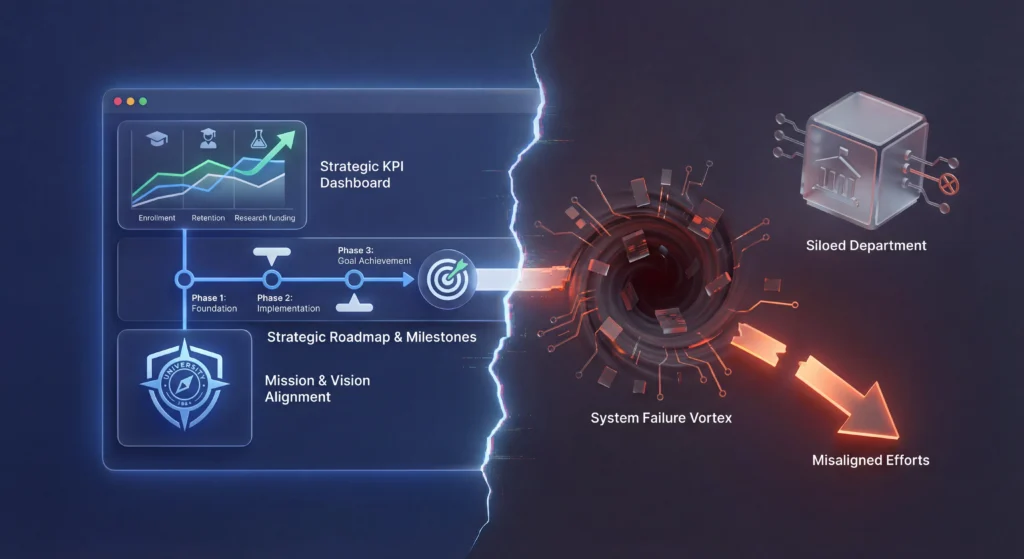
The problem is usually not that an institution has no strategic plan. The problem is that the plan does not actually run the institution. Many U.S. colleges and universities have a strategic plan on paper, but the goals are too broad, the ownership is too vague, the metrics are weak, and the budget never truly follows the strategy.
That is when strategic planning turns into an accreditation problem, a leadership problem, and a credibility problem. In the United States, accreditors expect planning to be mission-driven, measurable, resource-linked, inclusive, and reviewed regularly. When an institution cannot show that connection, planning starts to look performative instead of operational.
Need a Faster Starting Point?
Start with a Strategic Planning Review to identify the highest-risk gaps before they show up in accreditation, budgeting, or leadership decisions.
Across major institutional accreditors in the United States, strategic planning is not treated as a glossy document or a once-every-five-years retreat. It is treated as part of mission fulfillment, institutional effectiveness, accountability, and continuous improvement.
Strategic planning must begin with mission. Institutions are expected to show that the plan reflects educational purpose, student success priorities, and the institution’s intended future direction. Mission is not separate from planning. It is the frame that should drive priorities, choices, and resource decisions.
A real strategic plan includes measurable goals, meaningful indicators, and evidence that the institution is tracking progress. U.S. accreditors do not want vague aspirations. They want to see objectives, indicators, benchmarks, and documented use of evidence to refine decisions.
Planning is not credible if the budget ignores it. Strategic priorities must connect to financial planning, staffing, technology investments, academic support, and institutional capacity. If resources do not follow the plan, accreditors and institutional leaders will see the disconnect quickly.
Strategic planning should not be confined to a small executive group. U.S. accreditor expectations consistently point toward meaningful participation, comment opportunities, and visible alignment among leadership, boards, faculty, staff, and other appropriate constituencies.
A plan is not finished when it is approved. It has to be implemented, monitored, updated, and tied to improvement. Strong institutions can show progress, explain where results fell short, and document how they adjusted priorities, timelines, or resource assumptions.
For some accreditors, the expectations are even more specific. DEAC, for example, requires a strategic plan that addresses finances, academics, technology, admissions, marketing, personnel, and institutional sustainability, identifies responsible individuals and timelines, and is reviewed at least annually.
Strategic planning in higher education does not belong only to the administration. In U.S. colleges and universities, the governing board is expected to oversee mission, institutional direction, financial sustainability, and executive accountability while administration leads execution. That is why strategic planning and board governance should reinforce each other instead of operating in separate silos.
If your institution is also reviewing governance structure, board roles, or oversight responsibilities, this page should connect naturally to your board governance, risk management, and self-study work.
Talk with a Strategic Planning Consultant
We help institutions connect strategy to governance, budgeting, institutional effectiveness, and accreditation evidence.
We do not sell generic planning language. We provide accreditation-focused strategic planning support built for U.S. higher education institutions that need a plan leadership can actually use.
Some institutions need a full strategic plan build. Others need a reset, refresh, or implementation repair. We support both.
AI is changing strategic planning in higher education because it is changing how institutions teach, advise, recruit, operate, govern data, and manage risk. Across the United States, institutions can no longer treat AI as a side conversation inside IT or marketing. It now affects institutional strategy, resource allocation, compliance, student support, workforce planning, and public trust.
That means a modern strategic plan should define where AI supports mission, where human oversight is required, how vendors are evaluated, how privacy and accessibility are protected, and how the institution will measure both opportunity and risk.
Strategic planning also connects directly to board governance, institutional risk management, self-evaluation and self-study, online program compliance, change management, and the broader higher education accreditation process.

If you're new to state approval, start with our initial questionnaire. This provides a comprehensive understanding of your organization's readiness for state approval. FREE Initial Accreditation Assessment Questionnaire
Our goal is to help you achieve successful approval from your state and ensure the process is as efficient and stress-free as possible for you and your team. FREE (Reaffirmation) Assessment Questionnaire
Strategic planning in higher education is the institution-wide process a college or university uses to align mission, priorities, resources, evidence, and decision-making with long-term goals and continuous improvement.
Most institutions do not fail because they lack a plan. They fail because the plan is too vague, not tied to budget and accountability, detached from evidence, or ignored once it is approved.
U.S. accreditors want to see mission alignment, measurable goals, evidence-based planning, resource alignment, stakeholder involvement, implementation, and regular review tied to institutional effectiveness.
A strategic plan should be reviewed regularly, not shelved until the next cycle. At a minimum, institutions should monitor progress annually and update goals, timelines, and resource assumptions as conditions change.
Yes. We help institutions diagnose where planning is breaking down, reset goals and accountability, reconnect the plan to budgeting and evidence, and strengthen the plan for accreditation and leadership use.
AI affects academic strategy, student support, vendor risk, privacy, data governance, workforce planning, and institutional positioning. Strategic planning now needs a clear institutional approach to AI opportunities and risks.
Accreditation Expert Consulting helps colleges, universities, and training providers successfully navigate the BPPE approval process. From state readiness assessments to full compliance documentation, our team ensures your application meets California’s educational standards—efficiently and accurately.
Our goal is to help you achieve successful approval from your state and ensure the process is as efficient and stress-free as possible for you and your team.
“Accreditation Expert Consulting Team”
Our goal is to help you find exactly what you need and explore your options.
