Why COE Accreditation Matters in 2026
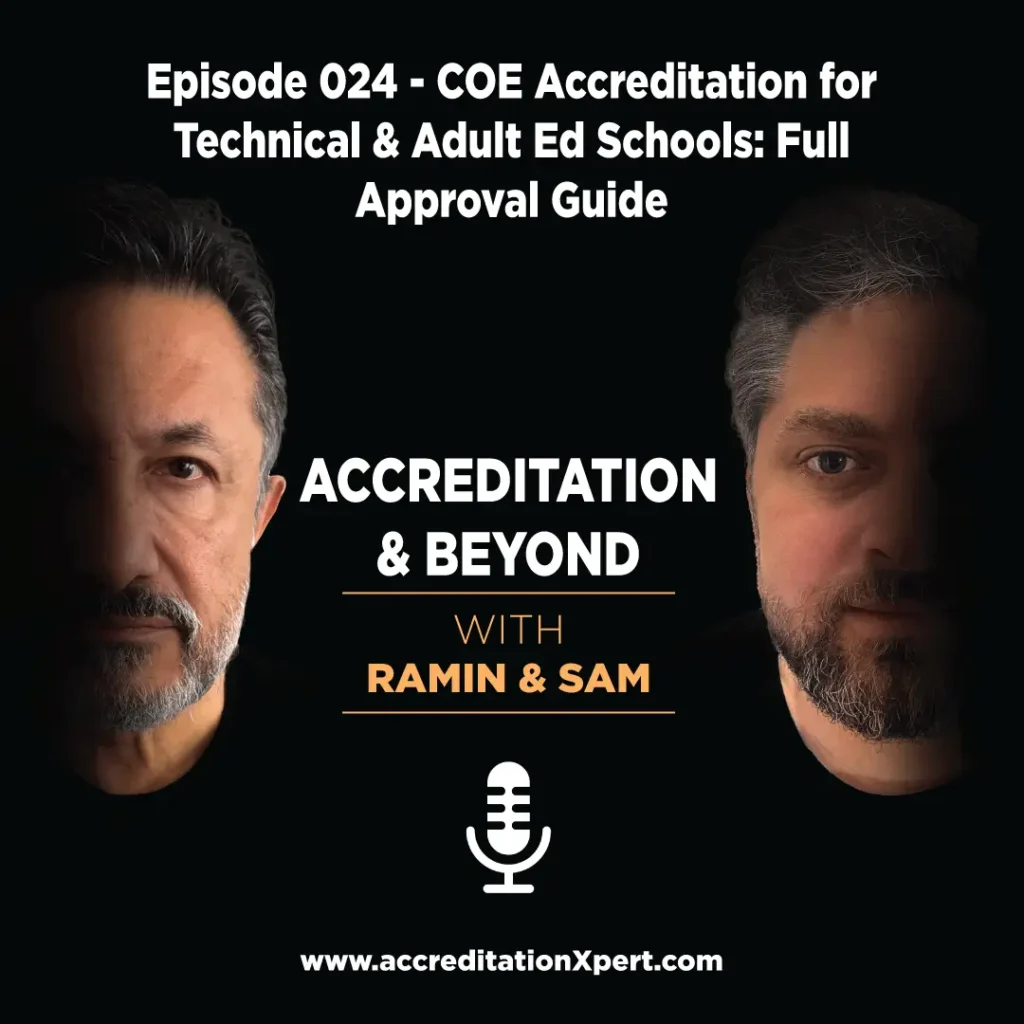
COE accreditation continues to be one of the most workforce-aligned institutional approvals available to technical and adult education providers. Ramin and Sam discuss how COE connects directly to local industry needs and why its focus on measurable student outcomes makes it especially relevant in today’s U.S. higher education climate. They emphasize how this accreditation supports access to Title IV federal financial aid and competitive state and federal workforce grants.
Eligibility Requirements That Catch Schools Off Guard
Many schools begin the COE process only to realize they’re not ready. This section outlines the most commonly misunderstood eligibility requirements, like proof of two years’ student data, completion rates, job placement records, and the need for an institutional advisory committee. Sam explains how even a strong school can get tripped up if the state licensure status isn’t fully secured.
Self-Study Report: How to Avoid Common Mistakes
The Self-Study Report (SSR) is often the heaviest lift in the process. Ramin walks through the major components of the SSR, including curriculum mapping, faculty credentialing, employer engagement, and student outcome tracking. The hosts share tips from schools that submitted strong SSRs, along with cautionary examples of rushed, incomplete, or overly narrative responses that led to deferrals.
What to Expect During the Team Visit
The on-site evaluation can feel daunting, but it doesn’t have to be. Sam outlines what COE team evaluators look for during their visit, from interviews with faculty and students to facility walkthroughs and file audits. The hosts also explain how schools can proactively prep staff and correct minor gaps before they become findings.
COE vs. Other Accreditors: Which Is Right for You?
In this candid comparison, Ramin and Sam explain how COE differs from accreditors like ACCSC, DEAC, and CAAHEP. COE is designed specifically for public and nonprofit technical institutions, with a focus on trade skills and workforce development. The hosts also share scenarios where a school might be better suited for a different national or programmatic accreditor.
Compliance After Accreditation: Annual Reports and Program Changes
Getting accredited is just the beginning. Ramin walks listeners through the post-approval responsibilities: annual reports via COE’s online portal, submitting substantive changes (like new programs or locations), and tracking job placement and licensure outcomes. Sam reinforces the importance of continuous engagement with the advisory board to stay aligned with employer expectations.
AEC Note
Whether you’re running a welding school, allied health institute, or adult education center, COE accreditation can be a powerful strategy to build credibility, improve operations, and access public funding. But it’s not a one-size-fits-all process. If your school is considering a COE application or preparing for a site visit, our team is here to help you avoid costly delays and meet every requirement with confidence.
Need help getting started? Listen to the full episode, share it with your academic team, and reach out to us at info@AccreditationXpert.com or call 1-833-232-1400 (that’s X-P-E-R-T). Our team is here to support your next step with clarity and confidence.