Introduction
DEAC accreditation for online colleges is not just a compliance exercise. It is a structured evaluation of how institutions deliver distance education, measure student outcomes, and maintain operational integrity.
Accreditation in higher education is widely recognized as a process that evaluates institutional quality, accountability, and continuous improvement, as outlined by the Council for Higher Education Accreditation (CHEA).
As more institutions expand into online programs to stabilize enrollment, understanding the DEAC accreditation process becomes essential for long-term credibility and Title IV readiness.
Quick Answer
DEAC accreditation for online colleges involves three core stages: eligibility verification, self-evaluation (SER), and external review including site visits. Institutions must demonstrate documented compliance, consistent student outcomes, and operational control across all distance education activities.
Key Takeaways
- DEAC focuses specifically on distance education accreditation
- A strong Self-Evaluation Report (SER) is critical
- Site visits include LMS review, faculty interviews, and evidence audits
- Most delays come from weak documentation and unclear outcomes
What Makes DEAC Accreditation Different for Online Colleges
DEAC accreditation differs from regional models because it evaluates institutions based on distance education delivery, flexibility, and measurable student outcomes. This makes it particularly relevant for online colleges scaling digital programs.
DEAC Eligibility Requirements and Application Readiness
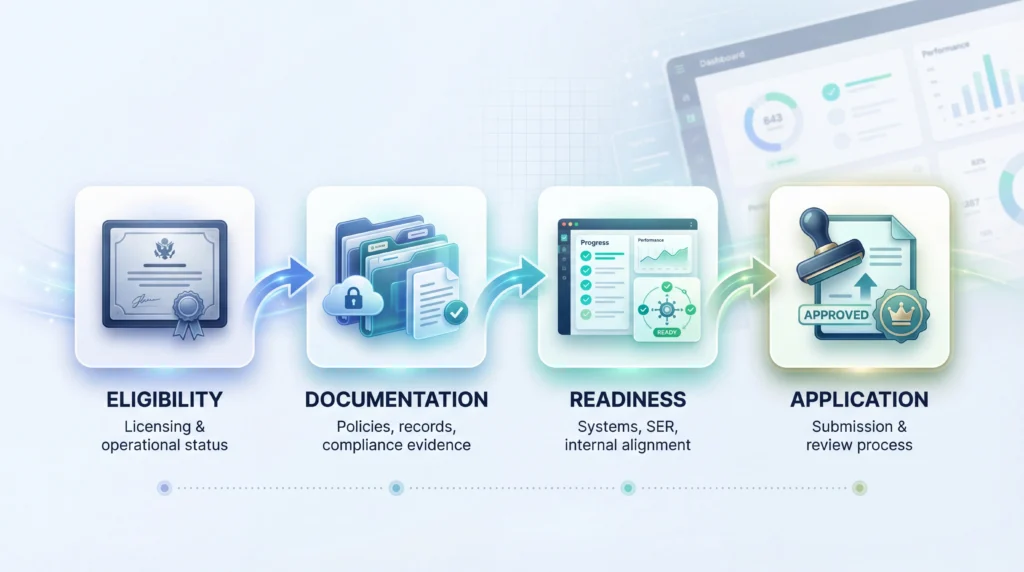
Before applying, institutions must meet DEAC eligibility requirements such as operational history, student tracking, and proper licensing. Many institutions fail at this stage not because they are unqualified, but because their documentation and compliance systems are not fully developed.
If your institution is still building its compliance structure, understanding the full higher education accreditation process can help you identify readiness gaps before engaging with DEAC.
Self-Evaluation Report (SER) for DEAC Accreditation
The DEAC self-evaluation report (SER) is the backbone of the accreditation process. It must clearly document program goals, student outcomes, faculty qualifications, and support systems.
Institutions that treat the SER as a formality typically fail. DEAC expects alignment between policy, practice, and documented evidence.
Curriculum, LMS, and Student Outcomes in DEAC Review
DEAC evaluates whether your online curriculum is structured, measurable, and consistent. This includes:
- Learning outcome clarity
- LMS functionality and engagement tracking
- Assessment and feedback systems
Weak outcome tracking is one of the fastest ways to lose credibility during review.
DEAC Site Visits and Evaluation Process
Even for online institutions, DEAC site visits are intensive. Evaluators review:
- Student records
- LMS demonstrations
- Faculty interviews
- Operational workflows
Institutions must prove that what is documented is actually happening in practice.
Common DEAC Accreditation Mistakes That Delay Approval
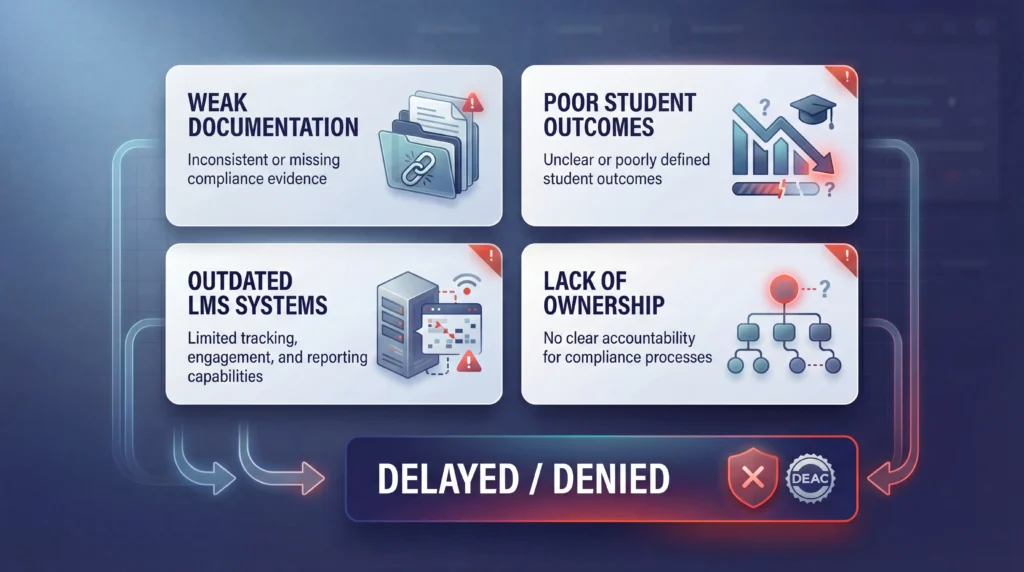
The most common issues include:
- Poor institutional research
- Outdated LMS systems
- Weak student outcome measurement
- Inconsistent documentation
- Lack of instructor training
These gaps signal weak compliance systems, not just isolated issues.
What Successful DEAC Accreditation Looks Like for Online Colleges
Successful institutions demonstrate:
- Consistent, well-controlled documentation across all compliance areas
- Clear alignment between institutional mission, programs, and measurable student outcomes
- Strong and transparent communication with DEAC throughout the accreditation review process
- A documented culture of continuous improvement, supported by data and internal review systems
DEAC accreditation for online colleges is not a one-time milestone. It is an operational system that must be maintained continuously through structured processes, assigned ownership, and routine monitoring.
Institutions that succeed are those that can clearly demonstrate how policies, operations, and evidence align in a consistent and repeatable way—not just during accreditation reviews, but as part of everyday operations.
Final Insight
DEAC accreditation for online colleges requires more than meeting minimum standards. It requires a compliance system that can withstand external review, operational changes, and long-term institutional growth.
Institutions that invest early in structured compliance systems, outcome tracking, and evidence control are significantly more likely to move through the DEAC accreditation process without delays, findings, or rework.
Next Steps: Building DEAC Accreditation Readiness
If your institution is preparing for DEAC accreditation or identifying gaps in documentation, compliance systems, or student outcome tracking, the next step is gaining clarity on what needs to be fixed—and how to fix it.
Our team works with institutions to assess readiness, identify compliance risks, and outline a clear, actionable path toward successful accreditation.
Contact our accreditation specialists to discuss your DEAC readiness
How long does it take to get DEAC accreditation for an online college?
The DEAC accreditation process typically takes between 18 to 36 months, depending on the institution’s readiness, documentation quality, and operational maturity. Institutions with well-developed compliance systems and a complete Self-Evaluation Report (SER) generally move through the process more efficiently, while others may experience delays due to gaps identified during review.
What are the core requirements for DEAC accreditation?
To qualify for DEAC accreditation, institutions must meet eligibility criteria such as legal authorization, operational history, and active student enrollment. They must also demonstrate structured academic programs, qualified faculty, measurable student outcomes, and a comprehensive Self-Evaluation Report (SER) supported by verifiable documentation.
What causes delays or denial in the DEAC accreditation process?
Delays or denial in the DEAC accreditation process are most often caused by inconsistent documentation, weak student outcome assessment, outdated learning management systems (LMS), and lack of clear internal ownership of compliance processes. Institutions that cannot demonstrate consistent, evidence-based operations during review are more likely to face findings or extended timelines.