
By Dr. Ramin Golbaghi · Updated October 2026
A quality management system for accreditation (QMS) is the routine a school runs all year to show that it meets its accreditor’s standards: each standard has an owner, a process, records on file and a date when someone reviews the results and acts on them. It is a different thing from ISO 9001 certification.
This guide covers five institutional accreditors of career schools and colleges: the Accrediting Commission of Career Schools and Colleges (ACCSC), the Accrediting Council for Continuing Education & Training (ACCET), the Council on Occupational Education (COE), the Distance Education Accrediting Commission (DEAC) and the Accrediting Bureau of Health Education Schools (ABHES). None of them mentions ISO in its current standards, and none uses the phrase “quality management system.” Each asks for the same cycle under its own name, and each checks it by looking for proof that the cycle ran.
This guide is for owners, school directors and compliance officers at private career schools, allied health schools and colleges. Its author, Dr. Ramin Golbaghi, founded and led a private postsecondary institution and personally obtained its ACCSC institutional accreditation.
These five accreditors judge a quality system by the records it leaves. At an ACCSC renewal, the on-site team needs “implementation documentation for institutional assessment and improvement activities.” ACCET asks for an institutional effectiveness plan updated at least annually; COE and DEAC ask for a strategic plan reviewed every year; ABHES asks for a Program Effectiveness Plan for every program, every year.
What a Quality Management System for Accreditation Covers
Read the five accreditors’ standards side by side and the same QMS framework shows up in each one:
- Goals tied to the school’s mission.
- Data on how students and programs are doing: completion or graduation, placement, licensure or certification exam results, and survey feedback.
- A scheduled review of that data by the people who run the school.
- Changes made because of the review.
- Records that prove each step happened.
ACCSC states the duty most plainly. Its Standards of Accreditation say: “The school must demonstrate that it engages in significant and ongoing institutional assessment and improvement activities appropriate to the size and scale of the school’s operations and that support the management and administration of the school as well as the quality of education provided.” The verb that matters is “demonstrate.” A plan nobody followed shows nothing. Minutes, action logs and changed procedures do.
The duty begins one level up. The U.S. Department of Education’s rules for recognizing accreditors require them to set clear expectations for student achievement and to have each school complete a self-study that “highlights opportunities for improvement, and includes a plan for making those improvements.” A QMS is how a school already has those improvements on record when the self-study starts.

The Same Quality Cycle Under Five Accreditors
Each row below uses the accreditor’s own term and its current edition, read in October 2026. The last column names the records to have ready for a reviewer or an on-site team.
| Accreditor and Document | Name in Its Standards | What Must Exist | Review Cycle | Records to Have Ready |
|---|---|---|---|---|
| ACCSC (Accrediting Commission of Career Schools and Colleges), Standards of Accreditation, July 1, 2026 | Institutional assessment and improvement activities | Ongoing activities sized to the school, in ten named areas that include management, fiscal condition, faculty and staff development, curricula and student achievement outcomes. Planning with goals, timelines and benchmarking is encouraged | Ongoing; program evaluation at set intervals; an Annual Report every year | Implementation documentation for the activities, such as purchase orders or invoices for equipment bought as a result |
| ACCET (Accrediting Council for Continuing Education & Training), Document 2, Revised August 2023 | Institutional effectiveness plan | A written plan with specific, measurable goals for one year or two to three years; for each goal, strategies, time frames, resources and a method of evaluation | Updated at least annually; progress “reviewed at least bi-annually” | Progress against each goal; completion data and, for vocational schools, placement data |
| COE (Council on Occupational Education), Handbook of Accreditation, Effective July 1, 2026 | Written strategic plan, plus a program outcomes follow-up plan | Objectives for at least three years, updated annually; strategies for programs below completion, placement or licensure benchmarks | Reviewed every year by faculty, staff, administration and the institutional advisory committee | A permanent accreditation file in chronological order, including the last self-study and every annual report |
| DEAC (Distance Education Accrediting Commission), Accreditation Handbook, 32nd Edition | Institutional Planning and Effectiveness | A strategic plan covering finances, academics, technology, admissions, marketing, personnel and sustainability, with named owners, timelines and resources; a plan to evaluate programs, student services and operations | Strategic plan reviewed at least annually; student achievement data evaluated annually | Evidence of compliance with every standard; the Self-Evaluation Report, shared with the on-site team |
| ABHES (Accrediting Bureau of Health Education Schools), Accreditation Manual, 19th Edition, Effective June 9, 2026 | Program Effectiveness Plan (PEP) | One plan for each program, covering nine elements that include retention, credentialing exam participation and pass rates, placement, surveys, employer feedback and curriculum | Assessed annually and distributed every year to administration, program staff and the advisory board | Each rate worked out by the ABHES method; for surveys, the counts behind the rate, since “the rate alone is not acceptable” |
Two differences matter when you build the system. ACCET, COE, DEAC and ABHES ask for a written plan on a stated cycle. ACCSC’s current standard asks the school to demonstrate ongoing activities, and it calls planning with goal setting, timelines and benchmarking “a useful practice” that it encourages. ABHES works at the program level, so an allied health school with four programs keeps four PEPs.
Weak outcomes turn the plan into required work. ACCSC may require a school that reports a graduation or employment rate below its benchmarks “to implement a plan for improvement and submit periodic progress reports.” ACCET requires a narrative analysis and “an operational plan for improving these rates within a designated time frame” for programs below its completion or placement benchmarks.
Six Parts of a QMS That Hold Up at a Site Visit
The accreditors name the outcomes and the cycle. They leave the internal machinery to the school. These six parts are the structure AEC looks for when it reviews a school’s quality records, and each one leaves a record an on-site team can read.
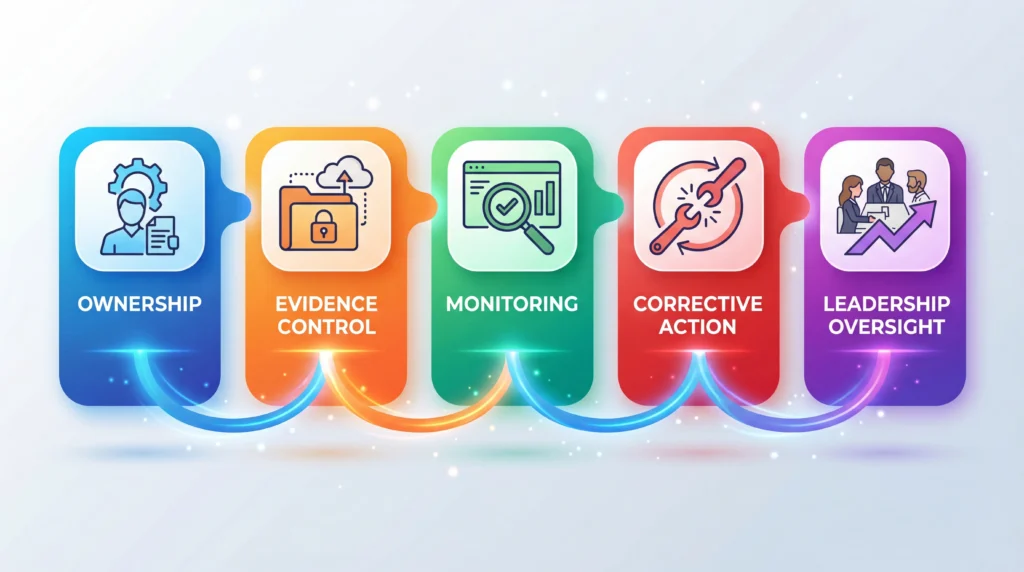
- A Standards Crosswalk. One line per standard: the person who owns it, the routine that meets it, the record that routine leaves, and the date of the next check. The owner needs the authority to ask for records and set deadlines. A committee can advise, but one name goes on each line.
- An Evidence Index. The list of records the crosswalk points to, with where each one is kept, which version is the live one and who approved it. ACCSC describes the on-site evaluation as a step to “verify data in the school’s reports, applications, responses, and any other information submitted to the Commission,” so every figure a school reports needs a record that staff can produce on request.
- A Data Calendar. When each outcome is pulled and when advisory committees meet. ACCSC tells schools to gather information internally and externally, and names Program Advisory Committees, employers and school graduates among the outside sources. Set the calendar so the numbers are reviewed before the annual report is filed.
- Scheduled Reviews. A meeting on a fixed cycle where owners look at the data and the open actions. ACCSC wants program evaluation that is “ongoing with set intervals for evaluation”; COE, DEAC and ABHES set the cycle at least once a year. Minutes with attendees, decisions and owners are the record.
- Corrective Action with an Effectiveness Check. Each problem the reviews find gets an owner, a change to the routine behind it and a later date to confirm the change worked.
- Leadership Review and Training. Directors read the results and sign off on each change in the minutes. ACCSC’s current standards add a training duty: “Members of school management and administrative employees must participate in ongoing development and training activities that support their particular roles in the school including as applicable, ACCSC requirements and procedures.” Keep the training log beside the review minutes.
Correction vs Corrective Action: A School Example
A file review finds an enrollment agreement with no student signature. Getting the agreement signed is the correction: it fixes that one file. The corrective action asks why the admissions process let an unsigned agreement through, changes the step (for example, the registrar will not activate a student record until the signed agreement is scanned), and sets a date to pull a sample of new files and confirm every one is signed. Without that check, nobody can show the problem is gone.
If a finding has already arrived from your accreditor, the order changes: start with the cause and the response the accreditor is waiting for. Our guide to root cause analysis and corrective action after a finding covers that sequence.
How to Build a Standards Crosswalk
Start from the edition your accreditor has in force. ACCSC republished its Standards of Accreditation with a July 1, 2026 date and announces revisions through its Accreditation Alerts, so a crosswalk built on the 2025 edition is already out of date. Then write one line per standard in the order the accreditor uses. Departments come in as owners.
Example Line: ACCSC Institutional Assessment and Improvement
- Owner: the school director.
- Routine: a quarterly review of graduation and employment data, student and graduate surveys, and Program Advisory Committee comments.
- Record: the minutes, an action log with an owner and due date for each item, and proof of each change. ACCSC’s own on-site preparation guide gives “copies of purchase orders or invoices to show the school purchased new equipment” as an example.
- Next Check: the first review after each action’s due date.
Three mistakes are worth checking for before a visit:
- An owner who cannot require records from other departments.
- A policy listed as the evidence. A policy shows intent; a completed record shows the routine ran.
- A crosswalk that covers only the standards the school finds easy.
One Crosswalk for Every Approval

A career school rarely answers to its accreditor alone. Add a column for each other body that reads the same records:
- the state agency that approves the school to operate (in California, the Bureau for Private Postsecondary Education, or BPPE);
- the U.S. Department of Education, for Title IV certification;
- the state approving agency, for VA education benefits approval;
- the state agency that keeps the Eligible Training Provider List under the Workforce Innovation and Opportunity Act, for WIOA/ETPL eligibility;
- the Student and Exchange Visitor Program, for SEVP certification.
Each body applies its own rules to the same record, so the column names the rule as well as the record.
Who Writes the QMS
The school’s own staff. COE’s Handbook is explicit: “Clear indication must exist that the faculty and staff were responsible for preparing, revising, and editing any documents required in the accreditation process.” ACCSC makes the same point about self-evaluation: “Improvements within a school should be due primarily to its internal efforts rather than to an on-site evaluation by an outside team.” COE also requires a school to send the Council the resume of any consultant it hires to help with accreditation, and consultants must not be present during Council site visits.
Outside help has a narrower job. AEC reviews your crosswalk and evidence index against the standard each line answers, runs mock site visits that test whether staff can produce the records, and works with your compliance officer on the review calendar. Your team keeps the system running between visits.
How the QMS Feeds the Self-Evaluation Report
ACCSC defines the Self-Evaluation Report (SER) as “an assessment of the school’s effectiveness in achieving its announced educational objectives and compliance with accreditation standards,” and expects self-evaluation to be “a permanent part of its operations.” When the crosswalk, the evidence index and the review minutes already exist, writing the SER becomes a matter of assembling and explaining them. ACCSC’s on-site preparation guide also tells schools to familiarize staff with the Application for Accreditation and the SER, which form the basis of the on-site team’s review.
The other accreditors work the same way. DEAC shares the SER with its on-site team and states that “Partial compliance is not sufficient to be awarded accreditation.” COE requires every accredited school to keep a permanent accreditation file holding the last self-study, team reports, responses and annual reports, and warns that failing to keep it “will call into question the administrative capability of the institution.” For the writing itself, see our guide to self-study preparation.
Facing your first visit under a new edition of your accreditor’s standards? Bring your current plan, your last annual report and your last visit report to an introductory meeting, and we will go through which records each standard asks for.
Frequently Asked Questions
Is a QMS the Same as ISO 9001 Certification?
No. None of the five accreditors in this guide asks for ISO 9001 certification: a search of the current ACCSC, ACCET, COE, DEAC and ABHES standards finds no mention of ISO. A school may borrow an ISO-style structure to organize its records, but the on-site team still reads them against the accreditor’s own standards.
What Does QMS Compliance Mean for a School?
It means the school can show, with dated records, that each accreditor standard has an owner, that the routine behind it ran on schedule, and that problems the reviews found were fixed and checked. A policy manual alone does not show compliance.
How Often Should a School Review Its Quality System?
At least once a year for the plan itself. ACCET, COE, DEAC and ABHES set an annual cycle in their standards, and ACCET also requires progress to be “reviewed at least bi-annually.” ACCSC asks for ongoing activities and for program evaluation at set intervals.
Who Should Own the QMS at a Small School?
The school director or chief academic officer, with one named owner for each standard. ACCSC sizes the duty to “the size and scale of the school’s operations,” so a small ACCSC school can run the cycle with a short monthly meeting that leaves minutes and an action log. Under ACCET, COE, DEAC or ABHES, the written plan is still required.
About the Author
Dr. Ramin Golbaghi is the Founder and CEO of Accreditation Expert Consulting. He founded and led a private postsecondary institution and, as its owner, personally obtained six approvals: BPPE approval to operate, ACCSC institutional accreditation, Title IV certification, VA education benefits approval, WIOA/I-TRAIN workforce eligibility, and SEVP certification.

- Accrediting Commission of Career Schools and Colleges, Standards of Accreditation, effective July 1, 2026, and Accreditation Alerts. Also ACCSC’s Self-Evaluation Report form and its on-site evaluation guide, Blueprints for Success: Preparing for the On-Site Evaluation.
- Accrediting Council for Continuing Education & Training, Document 2, Standards for Accreditation, revised August 2023, and Document 28, Completion and Job Placement Policy.
- Council on Occupational Education, Handbook of Accreditation, effective July 1, 2026.
- Distance Education Accrediting Commission, DEAC Accreditation Handbook, 32nd edition.
- Accrediting Bureau of Health Education Schools, Accreditation Manual, 19th edition, effective June 9, 2026.