

Introduction
An ACCET Quality Management System (QMS) is the operational framework institutions use to maintain continuous compliance with ACCET standards. Rather than relying on last-minute narratives, successful ACCET accreditation depends on consistent institutional processes, clear oversight, and verifiable documentation that withstands external review. Institutions that design structured compliance systems around clearly defined higher education accreditation requirements are typically better positioned to demonstrate consistent institutional control and documentation discipline during accreditation review.
ACCET accreditation is not earned through persuasive writing at the end of a review cycle. It requires operating an institution that consistently demonstrates compliance through stable procedures, documented controls, and verifiable evidence. The ACCET Standards for Accreditation describe accreditation as a professional judgment of institutional quality and a process designed to encourage continuous improvement.
ACCET’s Standards also emphasize self-evaluation as a mechanism for strengthening institutional effectiveness, while confirming that the Commission retains the authority to interpret the standards and apply related policies and procedures. This is where a Quality Management System becomes essential. In an ACCET environment, a QMS is the practical operational structure that ensures every requirement has a responsible owner, a defined compliance process, verifiable evidence, and an ongoing monitoring cycle.
One additional reality institutions must consider is that ACCET documents evolve. For example, as of February 27, 2026, ACCET publicly noted proposed revisions to Documents 2 (Standards) and 19. Institutions should therefore always confirm they are working from the most current ACCET documentation before building a standards crosswalk or finalizing evidence controls.
Quick Answer
An ACCET Quality Management System (QMS) is a structured compliance framework that connects ACCET standards to institutional processes, accountable owners, documented evidence, and ongoing monitoring. A well-designed QMS allows institutions to demonstrate compliance consistently through controlled documentation, verifiable records, and repeatable oversight processes required for ACCET accreditation.
Key Takeaways
- Ownership is the foundation of an effective ACCET QMS. When responsibility is unclear, compliance gaps quickly appear.
- Evidence control is critical. Institutions must be able to reproduce exactly what documentation existed at the time of submission.
- Internal monitoring should follow a scheduled cadence rather than reacting only during accreditation preparation, helping institutions identify issues early and avoid situations that may later require an accreditation non-compliance investigation.
- Stable data definitions and documentation practices make annual and outcomes reporting significantly easier.
- Every ACCET Quality Management System should be built around the most current ACCET documents and policies published in the official ACCET Documents & Forms library.
What a QMS Means Under ACCET
Think of your ACCET Quality Management System (QMS) as the institutional “proof engine” behind your Analytic Self-Evaluation Report (ASER) and your ongoing compliance. ACCET evaluation teams do not show up for casual observation. Instead, the review occurs after an institution completes its internal evaluation and submits the ASER (and BASER, if applicable) through ACCET’s system, where peer reviewers assess the institution’s documented evidence and operational controls.
ACCET also makes it clear that the accreditation process is managed through its Accreditation Management System (AMS) and that hard copies of key materials are not accepted. A QMS designed for ACCET accreditation must therefore support electronic submission, stable documentation, and the ability to retrieve institutional records quickly when reviewers request supporting evidence.
Key Terms and Definitions
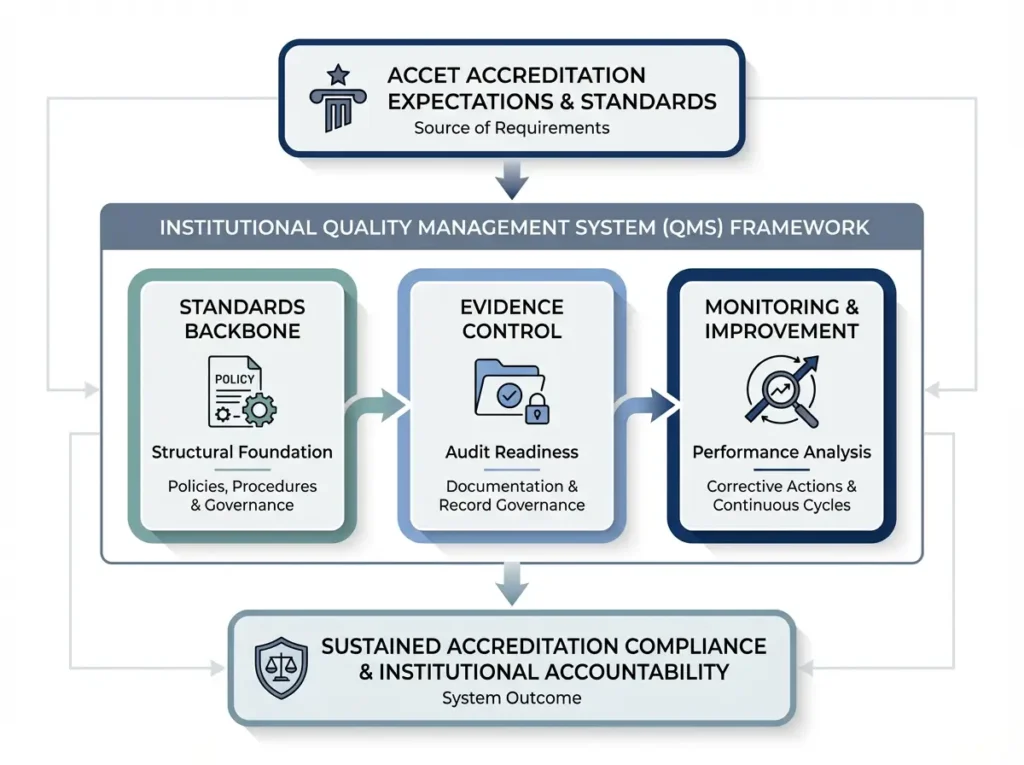
QMS: An ACCET Quality Management System (QMS) is the set of institutional processes, responsibilities, controls, and continuous improvement routines that enable institutions to maintain consistent compliance and documented evidence over time.
ACCET Standards Crosswalk: A structured working map that connects each ACCET Standard and related policy requirement to a responsible owner, the institutional process that ensures compliance, the supporting evidence, and the monitoring routine used to verify ongoing alignment.
Evidence Control: The institutional method used to store, version, retrieve, and preserve compliance evidence so that documentation remains consistent, reviewable, and defensible during accreditation review.
Internal Monitoring: Scheduled institutional reviews that confirm compliance processes are operating as described and that supporting evidence is consistently produced, maintained, and available for verification.
Corrective Action: A system-level response that identifies and resolves the root cause of a compliance gap, implements a documented fix, and verifies that the issue does not recur through follow-up monitoring.
The AEC ACCET-QMS Framework

The AEC ACCET-QMS Framework is designed to align with how ACCET actually reviews institutions: through documented records, structured evaluation, and verifiable evidence. In practice, an ACCET Quality Management System (QMS) serves as the operational structure that translates accreditation expectations into repeatable institutional processes, controlled documentation, and defensible compliance practices.
First, your QMS needs a clear standards backbone. The ACCET Standards for Accreditation together with ACCET’s policies and procedures define the criteria and review logic used for institutional evaluation and ongoing accreditation decisions. Institutions that build a stronger framework usually do so by aligning those standards with the broader higher education accreditation process rather than treating compliance as a one-time writing exercise.
Second, your QMS must be built around evidence discipline. ACCET makes clear that compliance is reviewed through the written record, that submissions are handled electronically, and that evidence should be preserved in a form that cannot be changed after submission. If an institution relies on live webpages or temporary media, it should preserve exactly what reviewers would have seen at the time of submission. That means evidence control is not administrative clutter. It is a core compliance function.
Third, your QMS must include monitoring and improvement. ACCET’s evaluation logic expects institutions to assess how effectively their operations support mission, performance, and educational quality over time. That only works when the institution has a repeatable system to detect gaps, verify corrective action, and demonstrate sustained improvement, which is exactly where structured accreditation review improvement practices become essential.
Step-by-Step: How to Build (or Rebuild) Your ACCET QMS
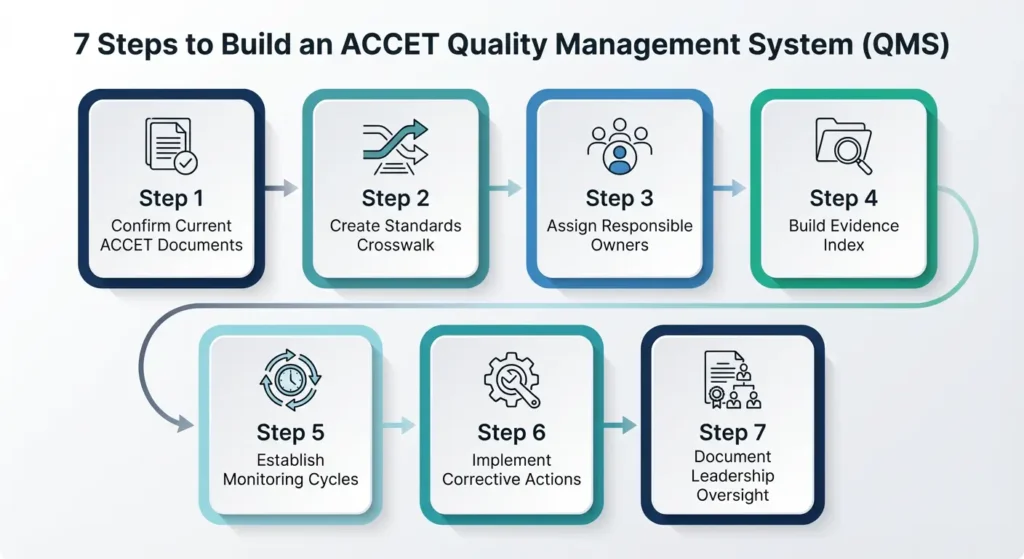
Step 1: Confirm you are working from current ACCET documents.
Before building your ACCET Quality Management System, confirm that you are working from the most current ACCET documentation. Begin with ACCET’s official Documents & Forms library and obtain the latest versions of Document 2 (Standards) together with any related policy documents or templates used in accreditation review. If ACCET publishes draft revisions or requests public comment, treat that as a signal to verify the final effective version before locking your standards crosswalk.
Step 2: Create an ACCET Standards Crosswalk.
Build a practical crosswalk that maps each ACCET Standard area to a responsible owner, the institutional process that ensures compliance, the supporting evidence, and the monitoring cadence that keeps documentation current. Institutions often strengthen this step by aligning the crosswalk with the broader types of accreditation in higher education, ensuring internal processes reflect how accreditation standards are structured across U.S. regulatory frameworks.
Step 3: Assign owners with authority, not just titles.
Each standard area should have a clearly accountable institutional owner with the authority to collect documentation, request corrective actions, and enforce compliance deadlines. When responsibility is vague or distributed across committees without clear leadership, compliance systems often become symbolic rather than operational.
Step 4: Build an Evidence Index aligned to your crosswalk.
Create an organized evidence index that lists the documentation required for each ACCET standard, including the artifact name, storage location, version date, and the specific requirement it supports. Institutions that implement structured evidence management are significantly better prepared for accreditation review and documentation verification.
Step 5: Establish internal monitoring cycles tied to accreditation risk.
Internal monitoring should operate on a predictable schedule rather than reacting only during accreditation preparation. Areas that historically produce compliance findings should be monitored more frequently, while stable operational areas may require less frequent review. Strong monitoring frameworks are also common in institutions implementing broader risk management in higher education practices.
Step 6: Create a corrective action routine that produces verifiable results.
When monitoring identifies a compliance gap, corrective action documentation should clearly record the ACCET requirement involved, the evidence deficiency, the root cause of the problem, the corrective action implemented, and the verification evidence demonstrating that the issue has been resolved. Without verifiable follow-up evidence, corrective actions are often viewed by reviewers as intentions rather than operational controls.
Step 7: Document leadership oversight and institutional accountability.
ACCET reviewers expect to see evidence that compliance oversight reaches the leadership level. Leadership review records should document what compliance information was reviewed, what decisions were made, what resources were allocated, and how implementation progress is tracked. Institutions that embed compliance oversight into executive governance structures tend to demonstrate stronger institutional accountability, similar to governance practices discussed in AI in higher education governance.
Evidence Control the ACCET Way
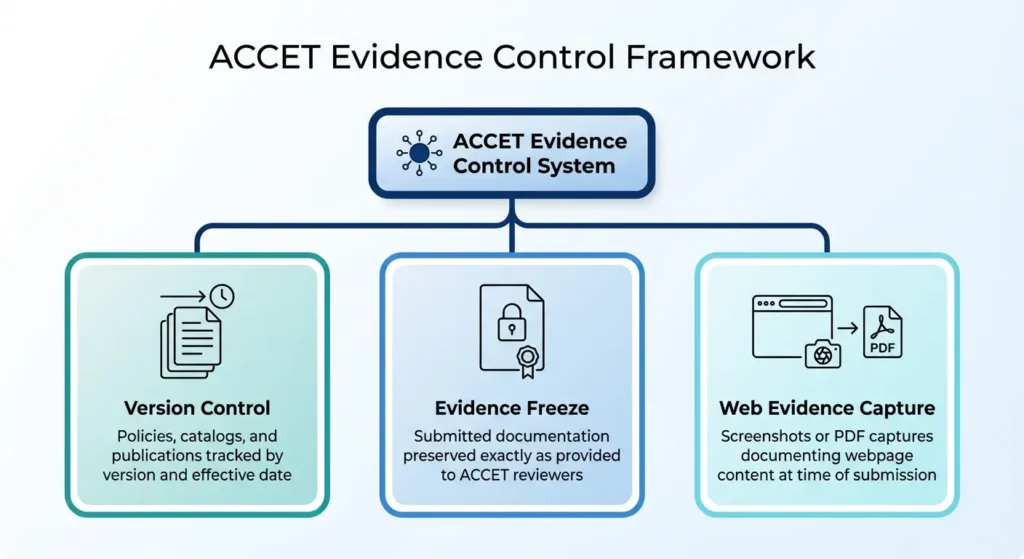
ACCET is unusually direct about evidence expectations. ACCET states that compliance reviews are conducted through the written record and that documentation must be provided electronically through its official submission systems. It also emphasizes that evidence must be preserved so it cannot be edited once submitted, and that references to live webpages should be supported by documentation showing the wording and appearance at the time of submission.
Practically, this means an ACCET Quality Management System (QMS) should include three core evidence controls. The first is version control for policies, catalogs, and student-facing publications so institutions can show which version was in effect during the review period. The second is evidence “freezing” for submissions so institutions can reproduce exactly what ACCET reviewers received. The third is screenshot or PDF capture rules for web content whenever an institutional webpage is used as accreditation evidence.
Monitoring, Reporting, and Outcomes (ACCET Expectations You Can Prove)
ACCET is explicit that maintaining accreditation requires ongoing reporting and documentation. For example, ACCET’s Annual Report and Enrollment Statistics (Document 12.b) must be submitted within thirty days after an ACCET-accredited institution’s fiscal year end. The information collected in this report is used to assess ongoing compliance and track institutional updates.
ACCET also places significant weight on outcomes documentation. Its Completion and Job Placement policy (Document 28) states that measurable outcomes serve as objective criteria tied to ACCET standards. Institutions must maintain completion and placement records in an orderly and verifiable format, and ACCET regularly reviews reported statistics with the authority to require external audits when necessary.
If you want your QMS to support ACCET rather than create unnecessary administrative work, outcomes monitoring should be embedded in normal institutional operations. That means data collection and verification occur on schedule, documentation remains audit-ready, and leadership can identify trends early enough to respond. This is especially important when institutions track job placement rates in higher education, which are often used as key performance indicators in accreditation reviews.
Common Mistakes
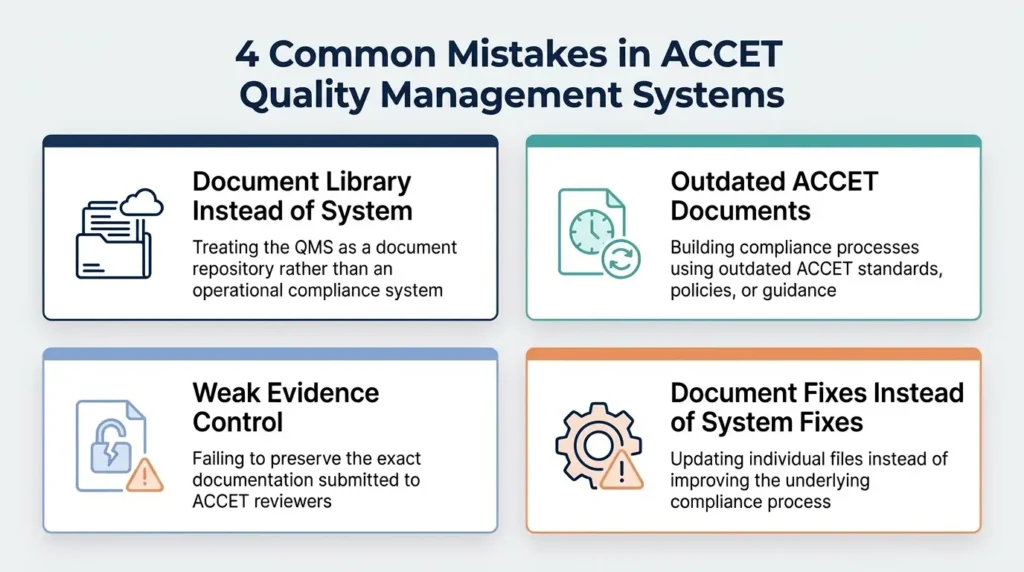
A common mistake institutions make is treating an ACCET Quality Management System (QMS) as a document library rather than an operational system. If the “system” only works when a specific compliance staff member is present, the institution does not actually have a system. It has a dependency that can quickly create compliance gaps.
Another frequent mistake is relying on outdated ACCET documents. ACCET periodically updates its standards, policies, and guidance materials. When an institution builds its standards crosswalk using an outdated document set, the result is avoidable misalignment between institutional practices and current accreditation expectations.
Weak evidence control is another major issue. Institutions sometimes rely on live webpages or uncontrolled documents without preserving what reviewers would have seen at the time of submission. If an institution cannot demonstrate which version of a policy, catalog, or procedure was active during the review period, it creates credibility concerns because ACCET evaluates compliance through a stable written record.
A final mistake is confusing document correction with system improvement. Updating a single file shortly before a review does not fix the underlying compliance process. ACCET reviewers evaluate whether institutional compliance systems operate consistently over time, not whether a specific document was temporarily corrected before evaluation.
What ACCET Reviewers Look For
ACCET reviewers evaluate whether an institution meets ACCET accreditation standards and can demonstrate this through clear documentation, consistent compliance processes, and verifiable evidence. During the accreditation review, institutions must show that their policies, procedures, and operational practices align with ACCET requirements.
Reviewers also assess whether the institution’s internal self-evaluation and reporting processes are credible. In practice, they look for clear alignment between requirements, institutional processes, and supporting documentation. Particular attention is given to measurable outcomes and record verification, especially where ACCET policies require documented evidence of institutional performance.
International Considerations
ACCET is a U.S.-based accreditor with defined standards and evaluation processes. Institutions pursuing ACCET accreditation must demonstrate compliance with ACCET requirements regardless of whether their operations are domestic or international.
If an institution operates internationally, enrolls international students, or delivers training across borders, its ACCET Quality Management System (QMS) must still produce ACCET-aligned documentation and evidence that meet ACCET reporting expectations.
At the same time, institutions should account for local legal and consumer protection requirements that may affect advertising practices, enrollment agreements, refunds, and student disclosures. These obligations vary by jurisdiction, so institutions should confirm applicable requirements with qualified legal counsel.
FAQ
What is the simplest way to explain an ACCET Quality Management System (QMS) to leadership?
An ACCET Quality Management System (QMS) is the institutional framework that keeps ACCET compliance running year-round. It assigns ownership for each requirement, controls documentation, monitors compliance activities, and records corrective actions so institutions can demonstrate compliance through verifiable evidence during an ACCET accreditation review.
Does ACCET require a specific QMS model like ISO certification?
No. ACCET does not require institutions to implement an ISO-style Quality Management System. Instead, institutions must demonstrate compliance with ACCET Standards, policies, and procedures through reliable processes, clear documentation, and verifiable evidence during accreditation evaluation.
Where should an institution start if it has limited time before an ACCET accreditation cycle?
Start with two tools: an ACCET Standards Crosswalk and an Evidence Index. The crosswalk connects each ACCET requirement to a responsible owner and compliance process, while the evidence index identifies where supporting documentation is stored and maintained.
How should institutions handle website pages used as ACCET accreditation evidence?
Institutions should not rely on live webpages as evidence. ACCET expects institutions to preserve documentation showing what the webpage displayed at the time of submission. Best practice is to archive webpages using screenshots or PDF copies.
What ACCET reporting deadlines should be included in a QMS compliance calendar?
At minimum, institutions should include the ACCET Annual Report and Enrollment Statistics (Document 12.b), which must be submitted within 30 days after the institution’s fiscal year end. Additional reporting requirements may apply depending on program scope and institutional status.
Next Steps
If ACCET accreditation or reaccreditation is on your institution’s timeline, avoid treating compliance as a last-minute writing exercise. Start by building the core structure of your ACCET Quality Management System (QMS): confirm current ACCET documents, develop a Standards Crosswalk, create an Evidence Index, and establish monitoring routines that keep compliance active year-round.
If you want expert support building a practical ACCET compliance system your team can actually maintain, schedule an ACCET accreditation consultation with AccreditationXpert.
About the Author
Accreditation Expert Consulting (AEC) supports higher education and training institutions with accreditation readiness, compliance systems, evidence organization, corrective action planning, and operational documentation designed to withstand accreditation review.
Author: Ramin Golbaghi, Founder and CEO of Accreditation Expert Consulting (AEC), an advisory firm specializing in accreditation compliance, institutional documentation systems, and accreditation preparation for U.S. and international institutions.

This article is provided for general informational purposes and does not constitute legal advice. ACCET standards, policies, procedures, and forms can be revised; always confirm requirements and current document versions using ACCET’s official Documents & Forms resources and published notices before making compliance decisions.